Sleep Calculator: How Much Sleep Do You Need by Age?
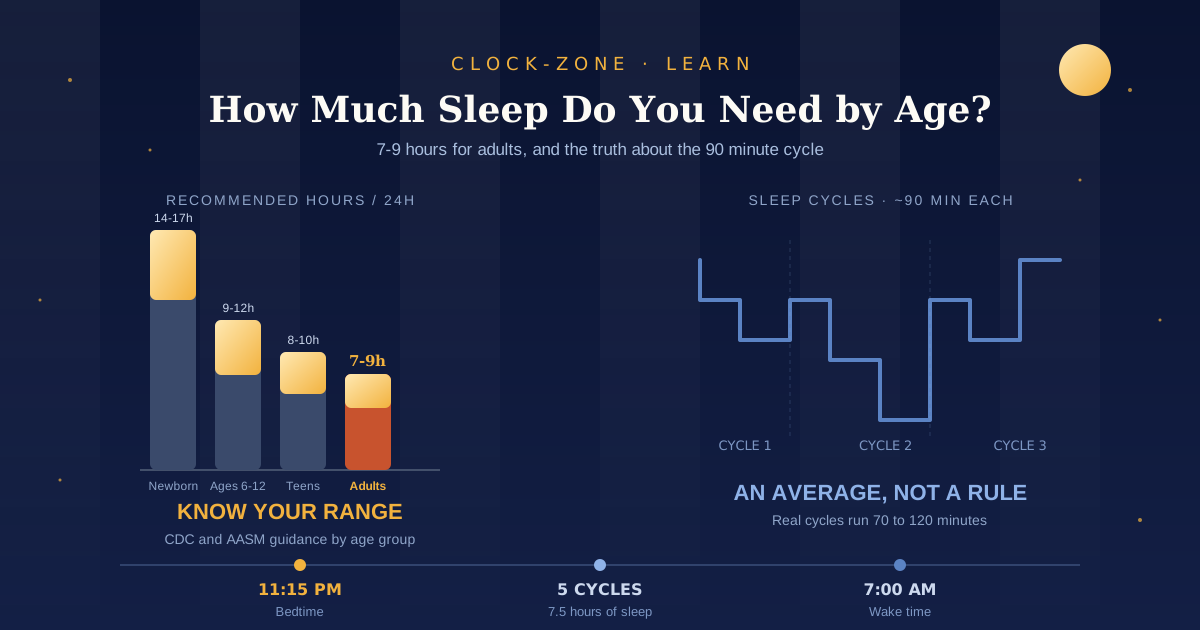
TL;DR: Most adults need 7 to 9 hours of sleep, teenagers need 8 to 10, and school-age children need 9 to 12. A sleep calculator works backwards from your wake time in 90 minute blocks, which makes a handy starting point but not a precise one. Real sleep cycles vary a lot between people. Setting the same wake time every day matters more than hitting a perfect number.
It is a familiar bit of late-night maths. You look at the clock, see 12:40am, and work out that if you fall asleep right now you will get six hours and twenty minutes. Then you lie there for another half hour and do the sum again.
That habit is more common than you might think. In 2024, 30.5% of US adults averaged less than seven hours of sleep in a 24 hour period, according to the CDC's National Center for Health Statistics. In the same survey, only a little over half said they woke up feeling well-rested on most days.
So how much sleep do you actually need by age, and can a sleep calculator help you get it? This guide covers the recommended hours for every age group, explains exactly how bedtime calculators do their maths, and looks at what recent research says about the 90 minute rule those calculators are built on. We built Clock-Zone.com as a set of free browser-based time tools, so the practical side of this, actually setting the alarm, is covered too.
The short video below gives a quick rundown of the recommended hours. This article picks up where it leaves off.
How Much Sleep Do You Need by Age?
Adults aged 18 to 64 need 7 to 9 hours of sleep per night, and adults over 65 need 7 to 8. Teenagers aged 13 to 18 need 8 to 10 hours, children aged 6 to 12 need 9 to 12, and preschoolers aged 3 to 5 need 10 to 13 including naps. Newborns need the most, at 14 to 17 hours across a full 24 hour period.
Those adult figures come from the CDC, which advises that adults aged 18 to 60 sleep at least seven hours each night. The figures for children come from a consensus statement by the American Academy of Sleep Medicine, whose panel reviewed 864 published studies before settling on its recommendations. The American Academy of Pediatrics endorsed them.
Here is the full breakdown.
| Age group | Recommended sleep per 24 hours |
|---|---|
| Newborns (0 to 3 months) | 14 to 17 hours |
| Infants (4 to 12 months) | 12 to 16 hours, including naps |
| Toddlers (1 to 2 years) | 11 to 14 hours, including naps |
| Preschoolers (3 to 5 years) | 10 to 13 hours, including naps |
| School-age children (6 to 12 years) | 9 to 12 hours |
| Teenagers (13 to 18 years) | 8 to 10 hours |
| Adults (18 to 64 years) | 7 to 9 hours |
| Older adults (65+) | 7 to 8 hours |
Why you will see slightly different numbers elsewhere
If you compare a few sources, the numbers will not always line up, and the video above is a good example. It gives 9 to 11 hours for school-age children and 12 to 15 for infants, which follow the National Sleep Foundation's long-standing ranges. The AASM and AAP figures are a little wider: 9 to 12 hours for school-age children, and 12 to 16 for infants aged 4 to 12 months.
Neither is wrong. Two expert panels looked at overlapping evidence and drew the boundaries in slightly different places. The practical takeaway is that these are ranges, not targets. If your ten year old sleeps 9 hours and wakes up alert and cheerful, that is a fine result under either set of numbers.
What happens when you hit the range
Regularly sleeping the recommended hours is linked to better attention, behaviour, learning, memory and emotional regulation in children, according to the AASM. On the other side, insufficient sleep in adults is associated with higher risk of obesity, diabetes, high blood pressure, heart disease, anxiety and depression, per the CDC.
One point worth being careful about. Short sleep and weight gain are linked in the research, but that is an association across large populations, not a promise that sleeping more will make you lose weight. Treat sleep as one part of general health rather than a diet strategy.
What Is a Sleep Calculator and How Does It Work?
A sleep calculator takes your wake time and works backwards in blocks of roughly 90 minutes, since that is the average length of one full sleep cycle. It then adds about 15 minutes for the time it takes you to fall asleep. The output is a short list of suggested bedtimes, each one landing you at the end of a cycle rather than in the middle of deep sleep.
The reasoning behind it is sound. Over a night you move through four to six sleep cycles, each one running through light sleep, deep sleep and REM. Waking at the end of a cycle, when sleep is lightest, tends to feel easier than being pulled out of deep sleep by an alarm.
The 15 minute buffer is not arbitrary either. A normal sleep latency for adults is about 10 to 20 minutes, which is the time between lights out and actually falling asleep. Calculators split the difference.
So the maths for a 7:00am wake time looks like this:
- 5 cycles of 90 minutes is 7.5 hours of sleep, so you need to be asleep by 11:30pm
- Add 15 minutes to fall asleep, and your bedtime is 11:15pm
That is the whole trick. No calculator is doing anything more complicated than this. Our own free sleep calculator runs the same maths for any wake or bedtime you enter, so you don't have to do it by hand.
Does the 90 Minute Sleep Cycle Rule Actually Hold Up?
Not as neatly as most calculators suggest. 90 minutes is a population average, not a fixed biological interval. A study of 6,064 polysomnographically recorded cycles found a median cycle duration of 96 minutes, with large variation between individuals, and the first cycle of the night was consistently shorter than the ones that followed.
That research, published in Sleep Medicine, used lab-measured sleep from healthy participants given an eight hour sleep opportunity. It also found that age and sex both affected cycle structure, with older participants showing longer non-REM and shorter REM sleep late in the night.
Other measurements agree that the range is wide. The Sleep Foundation notes that the first cycle often runs 70 to 100 minutes while later cycles fall between 90 and 120. So cycles are not even consistent within a single night, let alone between two different people.
What this means for your bedtime
It means treat calculator results as a starting range, not a precise instruction.
If your own cycles run closer to 75 or 105 minutes, a 90 minute calculation will drift further off with every cycle. By the fifth cycle, a 15 minute per cycle difference has moved your ideal wake time by more than an hour. That is why some people follow a sleep calculator faithfully and still wake up groggy.
The practical fix is simple. Pick the suggested bedtime closest to the total hours you need, try it for a week, and shift it by 15 minutes in either direction if mornings still feel rough. Your body will tell you more than the formula will.
Your Bedtime, Worked Out
Here are the bedtimes for five common wake times, calculated the way a sleep calculator does it: 90 minute cycles, plus 15 minutes to fall asleep. Find your wake time, then pick the row that gets you closest to the hours you need.
| Wake time | 6 cycles (9 hrs) | 5 cycles (7.5 hrs) | 4 cycles (6 hrs) |
|---|---|---|---|
| 6:00am | 8:45pm | 10:15pm | 11:45pm |
| 6:30am | 9:15pm | 10:45pm | 12:15am |
| 7:00am | 9:45pm | 11:15pm | 12:45am |
| 7:30am | 10:15pm | 11:45pm | 1:15am |
| 8:00am | 10:45pm | 12:15am | 1:45am |
A few notes on reading this table.
Five cycles is the sweet spot for most adults, since 7.5 hours sits inside the recommended 7 to 9 hour range. Six cycles suits anyone catching up after a short week, teenagers, or people recovering from illness. Four cycles is a short night, and it is fine occasionally, but it falls below the recommended minimum for adults and is not something to run on all week.
If your wake time isn't in the table, the sleep calculator works out the full list of bedtimes for any time you enter. You can also check the current time and count forward with the online clock if you are doing this maths at the end of a long day.
Why a Consistent Wake Time Beats a Perfect One
Going to bed and waking at similar times every day may matter more for your health than the exact number of hours you sleep. In a study of nearly 61,000 adults, people with the most regular sleep patterns had a 20% to 48% lower risk of death from any cause compared with the least regular group, and sleep regularity predicted mortality more strongly than sleep duration did.
That study, published in the journal Sleep, calculated a Sleep Regularity Index from more than 10 million hours of accelerometer data in the UK Biobank cohort. Higher regularity was also linked to lower cancer and cardiometabolic mortality, and the results held after adjusting for age, sex, ethnicity, lifestyle and health factors.
The researchers drew a fairly practical conclusion from it. As they put it, asking people to keep similar sleep times between days rather than devoting more of the day to sleep may be the more achievable strategy.
This reframes the whole exercise. Chasing a perfect cycle-aligned bedtime on Tuesday means very little if you sleep until noon on Saturday. A fixed wake time you keep seven days a week does more work than any calculator output.
Here is the order of priority that follows from the evidence:
- Same wake time daily, weekends included. This is the anchor.
- Enough total hours for your age group, from the table above.
- Cycle alignment, if you want to fine-tune after the first two are in place.
Most people start at number three. It is the least important of the three.
Signs You Are Not Getting Enough Sleep
The clearest signal is how you feel in the afternoon rather than how you feel at 6am. Nearly everyone is groggy on waking. If you are still fighting to stay alert at 3pm on a normal day, that points to a sleep shortfall rather than a bad morning.
How long you take to fall asleep is a useful self-check too. Falling asleep in under five minutes can suggest you are running a sleep debt, while regularly taking more than 20 to 30 minutes can point toward insomnia. Neither is a diagnosis on its own. As a Cleveland Clinic sleep specialist notes, the 10 to 20 minute window is a guide rather than a strict rule, and taking a bit longer is not automatically a problem if you wake up feeling fine.
Other things worth noticing:
- Needing an alarm to wake every single day, and struggling even then
- Falling asleep unintentionally during quiet activities
- Sleeping several hours longer on days off than on work days
- Trouble concentrating, remembering things, or driving safely
That last group matters. The CDC links insufficient sleep to motor vehicle crashes, industrial errors and medical errors causing real injury and disability.
If you have tried adjusting your schedule and still feel exhausted, or you consistently cannot fall asleep, speak to a doctor. Persistent sleep problems can have treatable causes, and a calculator cannot diagnose any of them.
Setting It Up With a Free Online Alarm Clock
The plan only works if the alarm actually goes off at the same time every day. That is the part people skip.
We built Clock-Zone to make this a three-tap job with nothing to install. Open the free online alarm clock, set your wake time, add a label like "same time, every day", and pick a sound. Quick-set presets cover the common wake times, so you are not scrolling through a picker every night. Keep the tab open and it rings.
A few things that help the habit stick:
- Set one alarm, not five. Snooze stacking fragments the last part of your sleep, which is when most of your REM happens.
- Use a wind-down cue. Set the countdown timer for 30 minutes before bed as a signal to put screens down.
- Travelling or working shifts? The world clock makes it easier to plan a wake time in a new time zone before you land.
There is no account to make and no app to download, which is deliberate. The fewer steps between deciding to fix your sleep schedule and actually setting the alarm, the more likely it is to happen.
The Takeaway
Three things to carry away from this.
First, know your number. Adults need 7 to 9 hours, teens need 8 to 10, and school-age children need 9 to 12. Anything else you read is a variation on those ranges.
Second, use a sleep calculator as a rough guide. The 90 minute cycle is a real average, but individual cycles vary widely, so treat the suggested bedtime as a starting point and adjust by 15 minutes until mornings feel better.
Third, prioritise consistency. The evidence for regular sleep timing is strong, and it is the one change that costs nothing and needs no equipment.
Pick your wake time from the table, set the alarm, and keep it the same tomorrow. That is most of the work.
Frequently Asked Questions
Is it better to sleep 6 hours or 7.5 hours?
7.5 hours is better. Six hours falls below the seven hour minimum the CDC recommends for adults, and short sleep is linked to higher risk of several chronic conditions. The idea that six hours is "safer" because it completes four cycles is a misreading. Total sleep time matters more than cycle count, so choose the longer option whenever you can.
Do you really wake up less groggy at the end of a sleep cycle?
Often yes, because sleep is lightest at the end of a cycle. But the effect is smaller and less reliable than sleep calculators imply, since cycle lengths vary between people and across a single night. If you consistently wake up foggy at a calculated time, shift your alarm by 15 minutes and see whether it improves.
How much sleep do teenagers need?
Teenagers aged 13 to 18 need 8 to 10 hours per 24 hours, according to the American Academy of Sleep Medicine. Most get less, partly because puberty shifts the body clock later while school start times stay early. That combination makes a consistent wake time harder and more important at the same time.
Does the 15 minute fall-asleep buffer matter?
It is a reasonable default, since a typical adult takes 10 to 20 minutes to fall asleep. If you know you drift off in five minutes or lie awake for 40, adjust your bedtime accordingly. Someone who regularly needs 40 minutes should go to bed 40 minutes before their target sleep time, not 15.
Can weekend catch-up sleep make up for a bad week?
Only partly. Extra weekend sleep can reduce some short-term sleepiness, but it also shifts your body clock and makes Monday harder. Research on sleep regularity suggests that keeping consistent sleep and wake times predicts health outcomes more strongly than total hours does, so a steady schedule beats a weekday deficit followed by a weekend surplus.
This article is for general information and is not medical advice. If sleep problems persist, talk to a doctor or a qualified sleep specialist.
Related Guides
- How to Stop Hitting Snooze — why snoozing is usually a symptom of exactly the sleep debt this guide helps you fix.
- Daylight Saving Time Explained — how the spring clock change disrupts sleep, and how to adjust faster.
- The Pomodoro Technique Explained — what the research says about breaks and fatigue during the day.