Daylight Saving Time Explained
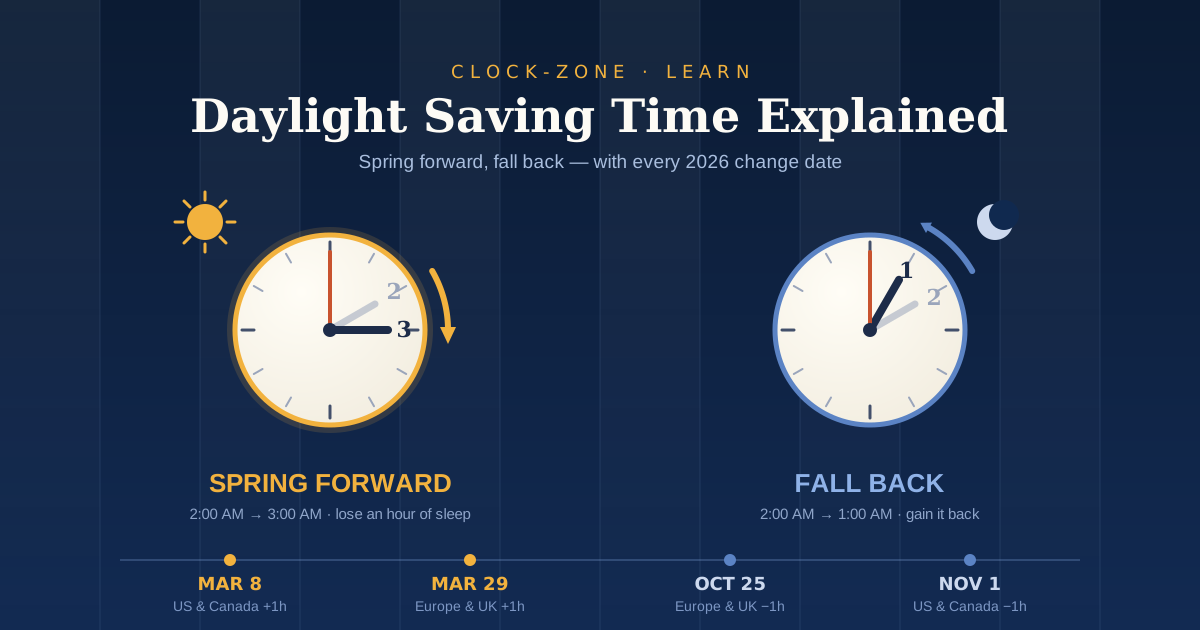
TL;DR: Daylight saving time (DST) moves clocks forward one hour in spring and back one hour in fall so daylight lands later in the evening. Around 70 countries observe it, on different dates, which scrambles international schedules twice a year. The original energy-saving rationale is now heavily disputed, and research links the spring change to short-term sleep and heart issues. This guide covers how DST works, the 2026 dates, and how to stay ahead of every change.
Twice a year, more than a billion people wake up mildly jet-lagged without going anywhere.
That's daylight saving time at work. One Sunday in spring, an hour of your morning vanishes. One Sunday in fall, it comes back. In between, meeting times drift, alarms mislead, and someone in your group chat asks "wait, did the clocks change this weekend?"
If you've ever wondered why we do this, whether it actually saves anything, and when exactly your clocks change next, this guide has you covered. We'll walk through what DST is, where the idea came from, what the research really says about energy and health, and the exact 2026 dates for every major region.
And because half of Clock-Zone's visitors land on our world clock during clock-change weeks trying to figure out what time it "really" is somewhere, we'll finish with a simple system so a time change never catches you off guard again.
What Is Daylight Saving Time?
Daylight saving time is the practice of setting clocks forward one hour in spring and back one hour in fall. The goal is to shift an hour of daylight from early morning, when most people are asleep, to the evening, when they can actually use it. The popular memory trick is "spring forward, fall back."
When DST is active, your region simply runs one hour ahead of its normal schedule. The period without DST is called standard time, or in Europe, winter time; the DST period is often called summer time. Technically, a region on DST moves one hour closer to UTC, the world's reference clock. New York goes from UTC-5 to UTC-4, and London from UTC+0 to UTC+1. If offsets are new to you, our guide to the UTC offset system explains it in plain English.
Not everyone plays along
Here's the twist that causes most confusion: DST is far from universal. Roughly 1.6 billion people in over 70 countries change their clocks, but that's a minority of the world. India, China, and Japan stay on the same time all year, and so does nearly all of Africa. So the time difference between a DST country and a non-DST country changes with the seasons, even though only one side touched its clocks.
Who Invented Daylight Saving Time and Why?
The idea is older than you'd guess, and it started as a bit of a joke.
Franklin's candle math
In 1784, Benjamin Franklin wrote a satirical essay suggesting Parisians could save a fortune on candles by waking up earlier to use morning sunlight. He never proposed changing clocks, just changing habits. Still, the seed was planted: daylight is free, and wasting it costs money.
Hudson, Willett, and the war
The modern proposal came over a century later. New Zealand entomologist George Hudson suggested a seasonal clock shift in 1895, mostly because he wanted more after-work daylight to collect insects. British builder William Willett championed the idea in 1907, campaigning for it until his death.
Governments finally listened during World War I. Germany adopted clock changes in 1916 to conserve fuel, and other nations followed fast. The United States introduced DST during the war as a resource-saving measure, and the energy argument became the official justification that has carried DST for a century since.
When Do the Clocks Change in 2026?
In 2026, the US and Canada spring forward on Sunday, March 8 and fall back on Sunday, November 1. Europe and the UK change later in spring and earlier in autumn, springing forward on Sunday, March 29 and falling back on Sunday, October 25. Southern Hemisphere countries run the opposite pattern because their summer is flipped.
Here's the quick reference table:
| Region | Clocks go forward | Clocks go back |
|---|---|---|
| US and Canada | March 8, 2026 | November 1, 2026 |
| Europe and UK | March 29, 2026 | October 25, 2026 |
| Australia (DST states) | October 4, 2026 | April 5, 2026 |
| India, China, Japan, most of Africa | No change | No change |
Even within DST countries there are holdouts. Hawaii, most of Arizona, and several US territories skip DST entirely and stay on standard time all year.
The mismatch weeks that break your meetings
Notice the gap between the US and European dates. From March 8 to March 29, 2026, the US had already sprung forward while Europe hadn't, so the New York to London difference temporarily shrank from five hours to four. A one-week version of the same mismatch returns in late October. If you schedule international calls, these are the weeks to double-check everything, and our guide on how to convert time between time zones covers exactly how.
Does Daylight Saving Time Actually Save Energy?
This is the awkward part of the DST story. The policy exists to save energy, but the modern evidence is mixed at best.
On the supportive side, the US Department of Energy studied the 2007 extension of DST and reported that the extra four weeks saved about 0.5 percent of the nation's electricity per day. That's small but real, roughly enough to power 100,000 households for a year.
Other research points the opposite way. A well-known natural experiment in Indiana found that DST actually increased residential electricity demand, costing households about 9 million dollars a year. The reason: whatever people saved on lighting, they spent on extra heating and air conditioning. And when Turkey abolished clock changes in 2016, researchers analyzing consumption from 2012 to 2020 found no measurable energy savings from the DST years.
The fair summary: DST was designed for a world of candles and incandescent bulbs. In a world of LED lighting and air conditioning, its original justification no longer clearly holds.
How Does the Time Change Affect Your Health?
The spring change disrupts your circadian rhythm, the internal body clock that governs sleep and waking. Because clocks jump forward overnight, most people lose real sleep, and studies link the days right after the switch to a short-term rise in heart attacks and strokes, especially in people with existing risk factors.
The most cited figure comes from a Michigan hospital study that found a 24 percent increase in heart attacks on the Monday after the spring switch. Research has also found stroke rates around 8 percent higher in the first two days after a transition, and more fatal traffic accidents after the spring change.
Some perspective helps here. These are short-lived spikes concentrated in vulnerable people, not a danger to everyone, and the "fall back" change is much gentler since you gain an hour instead of losing one. Long-term sleep habits matter far more to your health than one shifted hour. Still, the pattern is consistent enough that many sleep scientists now argue against clock changes altogether.
How to adjust faster
A few small moves soften the spring transition:
- Shift gradually. Go to bed 15 to 20 minutes earlier for the three or four nights before the change.
- Get morning light. Sunlight soon after waking helps reset your internal clock quickly.
- Ease up on Sunday and Monday. Skip the late caffeine, big meals, and intense late workouts right after the switch.
This topic touches on sleep and heart health, so one gentle note: if time changes consistently hit you hard, or you're managing a heart or sleep condition, it's worth mentioning to your doctor.
Will Daylight Saving Time Be Abolished?
Maybe, and the momentum is real, but the finish line keeps moving.
The European Parliament voted in 2019 to end mandatory clock changes across the EU, yet member states never agreed on the follow-through, so the twice-yearly switch continues for now. In the US, the proposed Sunshine Protection Act would make daylight time permanent nationwide; it passed the Senate in 2022 and advanced through a House committee in 2026, but hasn't yet become law.
Meanwhile, plenty of countries simply stopped waiting. Turkey, Russia, Brazil, and most of Mexico have all abolished seasonal clock changes in the past decade or so.
The sticking point: permanent which time?
Everyone tired of clock changes still has to answer a second question: keep permanent summer time (lighter evenings, darker mornings) or permanent standard time (lighter mornings, darker evenings)? Politicians tend to prefer bright evenings; sleep scientists mostly favor standard time because morning light suits our body clocks better. Until regions settle that debate, "spring forward, fall back" remains the default.
How Do You Stay on Top of DST Changes?
The reliable approach is to stop memorizing offsets and use tools that apply DST rules automatically. A live world clock or converter always reflects the current rules for every city, including regions that changed their laws recently, so you check reality instead of your memory.
That last part matters more than people think. Countries sometimes announce time changes only days or weeks in advance, which is impossible to track by hand. It's exactly why we built Clock-Zone to run on live rules in your browser, with no app and no account.
A simple twice-a-year routine:
- Mark the four dates. Add the US and European change dates to your calendar each year.
- Verify before you schedule. During March-April and October-November, glance at the world clock to confirm the current difference between your cities before sending any invite.
- Convert with a tool, not your head. The free time zone converter applies the correct DST rules for the exact date of your event.
- Re-check your alarms. Phones update themselves, but standalone devices don't. A browser-based alarm clock synced to your system time is a handy backup on change weekends.
Conclusion: An Old Habit Worth Understanding
Daylight saving time is a century-old policy built for an energy problem we've mostly outgrown, yet it still shapes the clocks of 70-plus countries. Now you know the essentials: clocks spring forward and fall back on different dates around the world, the energy case is shaky, the spring change genuinely disrupts sleep, and abolition is debated but not done.
Whatever lawmakers decide, you can opt out of the confusion today. Bookmark the world clock and free time tools on Clock-Zone.com, check the converter before cross-border calls in the shoulder seasons, and share this guide with the colleague who's an hour late every March.
The clocks may keep jumping. Your schedule doesn't have to.
Frequently Asked Questions
What does "spring forward, fall back" mean?
It's the memory trick for daylight saving time. In spring, clocks move forward one hour (you lose an hour of sleep), and in fall they move back one hour (you gain it back). The phrase tells you which direction to adjust any clock that doesn't update itself.
Why do the US and Europe change clocks on different dates?
Each region sets its own DST law. The US changes on the second Sunday of March and the first Sunday of November, while EU rules use the last Sundays of March and October. The result is a roughly three-week mismatch each spring and one week each fall when time differences temporarily shift.
Which countries do not observe daylight saving time?
Most of the world skips it. India, China, and Japan don't change clocks, and nearly all of Africa and much of South America stay on standard time year-round. Several countries abolished it recently, including Turkey, Russia, Brazil, and most of Mexico. Within the US, Hawaii and most of Arizona opt out.
Does the extra hour of daylight save electricity?
The evidence is mixed. A US Department of Energy report found small savings of about 0.5 percent per day, but an Indiana study found DST increased electricity use once heating and cooling were counted, and Turkey saw no measurable savings after ending clock changes. Most experts agree the original energy rationale is weak today.
How can I adjust faster to the time change?
Shift your bedtime earlier by 15 to 20 minutes for a few nights before the spring change, get sunlight soon after waking, and keep caffeine and heavy meals away from late evening on the transition weekend. Most people fully adjust within a few days. If time changes affect you strongly, consider raising it with your doctor.
Related Guides
- Daylight Saving Time Senate Debate — where the push to end the clock change actually stands.
- Countries With Multiple Time Zones — how DST rules interact with countries that already span several zones.
- Sleep Calculator: How Much Sleep Do You Need by Age? — for the sleep debt the spring change tends to expose.