The Pomodoro Technique Explained
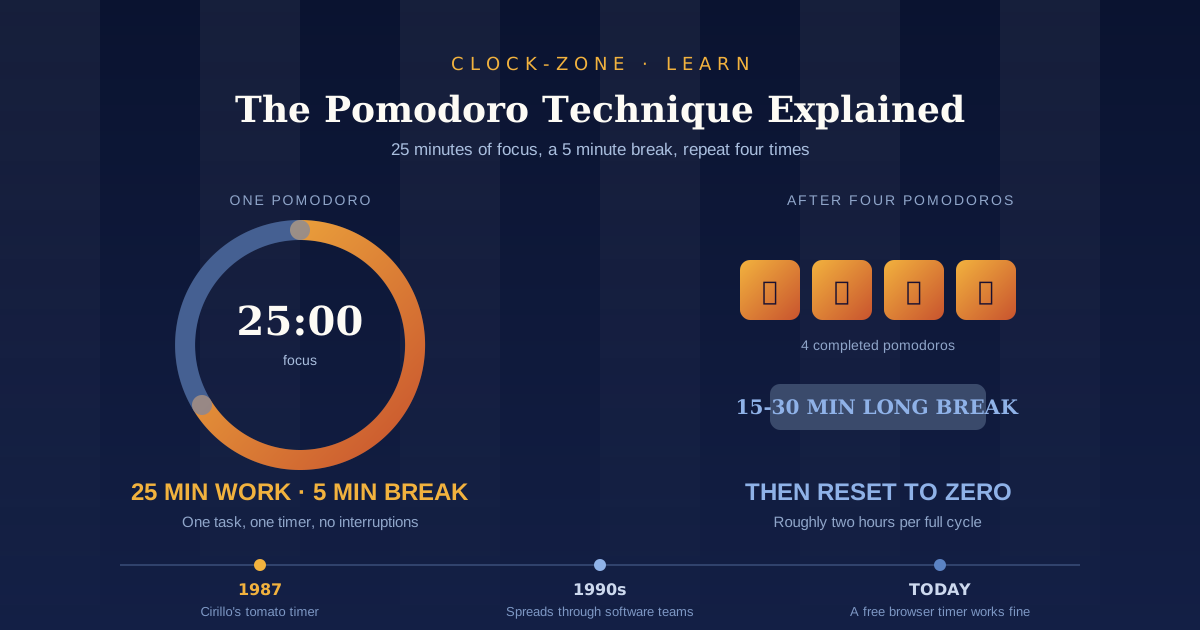
TL;DR: The Pomodoro Technique breaks work into 25-minute focus blocks separated by 5-minute breaks, with a longer break after four rounds. Francesco Cirillo created it in the late 1980s using a tomato-shaped kitchen timer. Research supports short breaks for cutting fatigue and lifting energy, though the exact 25/5 split isn't magic. Tune the interval to your task, then start your first session with a free browser timer.
Here's an uncomfortable number. The average person now holds attention on a single screen for about 47 seconds before switching away, down from two and a half minutes twenty years ago. Worse, recovering from a single interruption can take close to half an hour.
That's the problem the Pomodoro Technique was built to solve. And it solves it with almost nothing: one task, one timer, twenty-five minutes.
No app to install. No system to learn. No subscription. Just a promise you make to yourself for the length of one countdown.
This guide explains the Pomodoro Technique properly. You'll get the real story behind it, the six official steps, what the research actually supports (and where it falls short), the variations worth trying if 25 minutes feels wrong, and the mistakes that quietly ruin most people's sessions. At the end, you'll start your first Pomodoro in about sixty seconds.
What Is the Pomodoro Technique?
The Pomodoro Technique is a time management method that splits work into focused 25-minute intervals called pomodoros, each followed by a 5-minute break. After four pomodoros, you take a longer break of 15 to 30 minutes. The name comes from the Italian word for tomato, after the tomato-shaped kitchen timer its creator used.
That's the whole loop. Work, break, repeat, longer break.
What makes it different from "just try to focus harder" is that the timer makes the decisions for you. You don't have to judge when you're tired. You don't have to negotiate with yourself about whether you've earned a rest. The bell decides, and you obey it.
One pomodoro is also a unit of measurement, not just a block of time. Once you've run a few, you start thinking in them. A blog post is three pomodoros. Clearing your inbox is one. That estimate becomes surprisingly useful for planning a day.
It's worth knowing that the timer is only the entry point. The full method also covers daily planning, interruption management and effort estimation. Most people never go past the timer, and that's fine. The timer alone does most of the work.
The Story Behind the Tomato Timer
In the late 1980s, Francesco Cirillo was a university student who couldn't concentrate. His studies were piling up and every attempt to sit down and read fell apart within minutes.
A two-minute bet
So he made a small bet with himself. In his own telling, the question was simply "can I study for just two minutes without interruption?" He grabbed a tomato-shaped kitchen timer, wound it up, and started reading.
Two minutes worked. So he tried longer. Over the next five years he refined the intervals, the break lengths, and the rules for handling distractions, until the method looked roughly like it does today.
From one student to software teams worldwide
The interesting part is how it spread. In the 1990s Cirillo was mentoring software teams and noticed his clients had the same focus problem he'd had as a student. He suggested the timer. They laughed at him. One team tried it anyway, it worked, and they started talking about it at conferences. From there it moved through the software community and out into the wider world.
Cirillo eventually wrote a 160-page book about it. But as Todoist points out in its guide, what actually draws people in is the simplicity, not the depth. You can learn the core of it in ninety seconds, which is exactly what makes people try it.
How Does the Pomodoro Technique Work, Step by Step?
To run a Pomodoro session: choose one task, set a timer for 25 minutes, and work on only that task until it rings. Mark a checkmark on paper, then take a 5-minute break. After four checkmarks, take a longer break of 15 to 30 minutes and reset your count to zero.
Here are the six core steps as Cirillo published them, with what each one actually means in practice.
Step 1: Pick one task
One task. Not a project, not a category, not "work on the report and also answer emails." Something specific enough that you'd know if you'd finished it.
If the task feels too big to fit in 25 minutes, that's fine. Pick the next 25 minutes of it. "Write the introduction" beats "write the article."
Step 2: Set the timer to 25 minutes
Use anything that counts down and makes a noise. A free online timer works well here because it lives in a browser tab rather than on the device most likely to distract you.
Then make the small oath that comes with it: for these 25 minutes, I won't interrupt myself.
Step 3: Work until the timer rings
This is the part people get wrong, so it deserves a rule of its own. If something else pops into your head during the pomodoro (an email you forgot, a thing to google, a person to text), you don't act on it. You write it down on a piece of paper and go straight back to the task.
Almost every "urgent" thought that arrives mid-session turns out to be perfectly fine waiting 20 minutes. Writing it down gets it out of your working memory without costing you the session.
Step 4: Mark a checkmark
When the timer rings, stop and put a checkmark on your sheet. It sounds trivial. It isn't.
The checkmark does two jobs. It gives you a small visible reward for finishing, and it tracks how many pomodoros you've completed so you know when the long break is due.
Step 5: Take a short break
Three to five minutes, away from the screen. Stand up, get water, look out a window, stretch.
A 5-minute timer keeps this honest, because a break without a timer has a habit of becoming twenty minutes of scrolling.
Step 6: After four pomodoros, take a long break
Once you have four checkmarks, take 15 to 30 minutes off, then reset your count to zero and start again. A 30-minute timer covers the upper end of that window if you want a proper reset before the next block of work.
Four pomodoros plus breaks comes to roughly two hours. Most people find they can manage three or four of these sets in a working day, which is a more honest picture of real focus capacity than an eight-hour calendar suggests.
Why Does the Pomodoro Technique Actually Work?
The Pomodoro Technique works through three mechanisms: it lowers the barrier to starting because 25 minutes feels small, it forces recovery before fatigue accumulates, and it moves the decision to rest from your willpower to an external timer. The research supports the break structure more strongly than it supports any specific interval length.
Let's take those in order, and stay honest about the evidence.
Starting gets easier. A three-hour project triggers avoidance. A 25-minute commitment doesn't. You're not agreeing to finish the thing, only to spend one countdown on it. That reframe is most of the battle for anyone who procrastinates.
Breaks genuinely help, mostly with energy. A meta-analysis of 22 study samples covering 2,335 people found that micro-breaks produced statistically significant improvements in vigor and reductions in fatigue. The effects were real but small. Notably, the same analysis found no significant overall effect on performance, and it found that longer breaks boosted performance more than very short ones. So the 5-minute break is doing more for how you feel than for what you produce.
Timed intervals beat winging it. A scoping review of 32 studies covering 5,270 participants found positive correlations between Pomodoro use and focus, performance and time-management effectiveness, and concluded that time-structured intervals consistently outperformed self-paced breaks.
External cues beat internal ones. This is the subtle bit. As Brown University researchers explained in a fact-check of the method, switches prompted by an outside cue tend to be more efficient than switches you decide on yourself. The same piece points to the Zeigarnik effect: interrupted tasks are easier to pick back up than completed ones, which is why stopping mid-paragraph is often better than stopping at the end of a section.
And one honest counterpoint. Not every study is flattering. A comparison of break-taking techniques among 94 university students found that Pomodoro breaks led to a faster rise in fatigue and a faster drop in motivation than breaks the students chose for themselves. The differences didn't change overall fatigue or motivation levels, but it's a useful reminder that a rigid timer is not automatically better than good self-awareness.
The fair summary: the structure of short focused blocks with enforced rest has decent support. The number 25 does not have special scientific status. It's a reasonable default, nothing more.
Pomodoro Variations Worth Trying
If 25 minutes feels wrong, the answer isn't to give up on the method. It's to change the number.
Research on sustained attention suggests most people hold peak focus for somewhere between 20 and 45 minutes before hitting diminishing returns. That's a wide range, and where you fall in it depends on the task, the day, and you.
15/3 for dreaded tasks. When resistance is the problem rather than stamina, shrink the block. Fifteen minutes is hard to argue with. A 15-minute timer is often enough to break the inertia on something you've been avoiding for a week.
50/10 for deep work. Writing, coding and dense reading usually need a longer runway. Double the classic block and double the break.
52/17, the data-driven one. DeskTime analysed its users and found that the top 10% most productive worked about 52 minutes then broke for 17. A repeat of the study found the ratio had stretched further, to roughly 112 minutes of work and 26 minutes of break, as remote work changed people's rhythms. Treat these as observations rather than prescriptions, but the 3:1 work-to-break shape is a useful guide.
Flowtime for when you hate being interrupted. Instead of counting down, you count up: work until your focus naturally fades, note how long you lasted, then take a break proportional to that stretch. This needs an online stopwatch rather than a countdown, since the point is to measure rather than to limit.
Shorter blocks for ADHD. The standard interval is not a great fit for everyone. As PsychCentral notes, some people need longer than 25 minutes because shifting into focus mode takes them a while, and others do better with much shorter task blocks and very brief breaks. Experiment rather than assuming the default is correct.
One tip that applies to every variation. Gloria Mark's attention research suggests taking breaks at natural break points in a task, meaning places where you won't have to reconstruct much context when you return. If the bell rings mid-thought, finishing the sentence before you stand up is usually worth the extra fifteen seconds.
Six Mistakes That Ruin a Pomodoro Session
Most people who say the technique "doesn't work" are running into one of these.
1. Skipping the break. The break isn't a reward for good behaviour. It's the mechanism. Skip it and you're just working with an alarm going off occasionally.
2. Stacking tasks into one pomodoro. Three tasks in 25 minutes is not a pomodoro, it's regular multitasking wearing a costume. One task per block.
3. Using your phone as the timer. You pick it up to set 25 minutes and put it down 25 minutes later having set nothing. Keep the timer on the machine you're already working on, or on a device you can't scroll.
4. Treating a broken pomodoro as failure. Sessions get interrupted. Real jobs have colleagues and phone calls. When a pomodoro breaks, you void it and start a fresh one. That's the rule, not a punishment.
5. Spending the break on a feed. Five minutes of social media is not recovery for a tired brain, it's a different kind of load. Move your body or look at something far away instead.
6. Forcing the timer onto work it doesn't suit. This is the big one. Reaching deep focus can take 15 to 30 minutes of uninterrupted concentration, which means a 25-minute bell sometimes rings exactly when you've finally arrived. For flow-heavy creative work, open-ended brainstorming, meetings, or a job where interruptions arrive every ten minutes anyway, the standard Pomodoro is the wrong tool. Use a longer block, use Flowtime, or use nothing.
The rule that covers all six: the timer is your servant, not your master. If you're deep in flow when it rings, you're allowed to keep going.
One more practical note. If your sessions tend to sprawl past the end of the working day, set an online alarm clock for a hard stop. The technique is meant to make work finite, and an end time is part of that.
How Do You Start Your First Pomodoro Session Today?
To start right now: write down one specific task, close every browser tab you don't need for it, open a countdown timer, set it to 25 minutes, and begin. When it rings, stop and stand up for five minutes. That's a complete pomodoro, and you can run it in the next thirty seconds.
We built Clock-Zone on a simple idea: time tools should be instant. No download, no registration, no subscription, no setup screen between you and the thing you actually wanted to do. That matters more for this method than for almost anything else, because the moment you go install a focus app, you've already spent the focus you were trying to protect.
A freelance designer who uses the site told us she runs every Pomodoro session on our countdown timer, 25 on and 5 off, precisely because there's nothing in the way. Open the tab, hit start, work.
For your first session, keep it small:
- Pick a task you've been avoiding, not your most important one. The goal today is to prove the loop works, not to finish something.
- Put your phone in another room, or at least face down and out of reach.
- Keep a sheet of paper beside you for the distractions you're going to write down instead of chasing.
- Run one pomodoro. Just one. Decide afterwards whether to run a second.
If 25 minutes felt too long, try 15 tomorrow. If it felt too short, try 45. The number is yours to set.
Conclusion: An Old Habit Worth Understanding
The Pomodoro Technique has survived nearly forty years for a reason, and it isn't the number 25. It's that the method makes starting cheap and makes resting automatic, which are the two places most people's focus actually breaks down.
Three things worth keeping:
- The structure matters more than the interval. Focused block, enforced break, repeat. Everything else is tuning.
- The break is not optional. It's where the fatigue reduction and energy recovery come from, and it's the first thing people cut.
- Adapt it or abandon it, but don't fight it. If the timer is interrupting your best work, change the number or use a different method entirely.
You don't need to read another guide before you try this. Open our free online timer, set it to 25 minutes, and run one session on something you've been putting off. If it helps, bookmark all our free time tools and share them with your team.
Cirillo's line about his own discovery still holds up: the point is to turn time from an enemy into an ally. One countdown at a time.
Frequently Asked Questions
How long is one Pomodoro?
One pomodoro is 25 minutes of focused work on a single task, followed by a 5-minute break. After four pomodoros you take a longer break of 15 to 30 minutes. The 25-minute figure is the traditional default set by Francesco Cirillo, not a scientifically fixed number, so plenty of people run 15, 45 or 50-minute blocks instead.
What should I actually do during a 5-minute Pomodoro break?
Move away from your screen. Stand up, stretch, walk to another room, get water, or look at something far away to rest your eyes. Avoid social media and email, since those give your brain a new task rather than a rest. Research on micro-breaks suggests these short pauses help most with energy and fatigue, so the aim is genuine recovery, not a different screen.
What happens if I get interrupted in the middle of a Pomodoro?
If the interruption is something you can postpone, write it on a sheet of paper and return to your task immediately. If you genuinely have to stop, the standard rule is that the pomodoro is void: you abandon it and start a fresh one afterwards. There's no partial credit, which sounds harsh but keeps the unit meaningful.
Does the Pomodoro Technique work for studying?
Often, yes. A review of 32 studies covering more than 5,000 participants found that structured timed intervals improved focus and performance compared with self-paced breaks. It suits detail-heavy subjects and reading-heavy courses particularly well. One study of university students did find that Pomodoro breaks increased fatigue faster than self-chosen breaks, so if the fixed rhythm feels draining, adjust the interval rather than forcing it.
Do I need a special Pomodoro app, or will any timer do?
Any countdown timer works. Cirillo invented the method with a plastic kitchen timer, and a browser timer does the same job without an install or an account. A dedicated app can help by switching between work and break automatically and counting your completed sessions, but none of that is required to get the benefit.