Countries With Multiple Time Zones
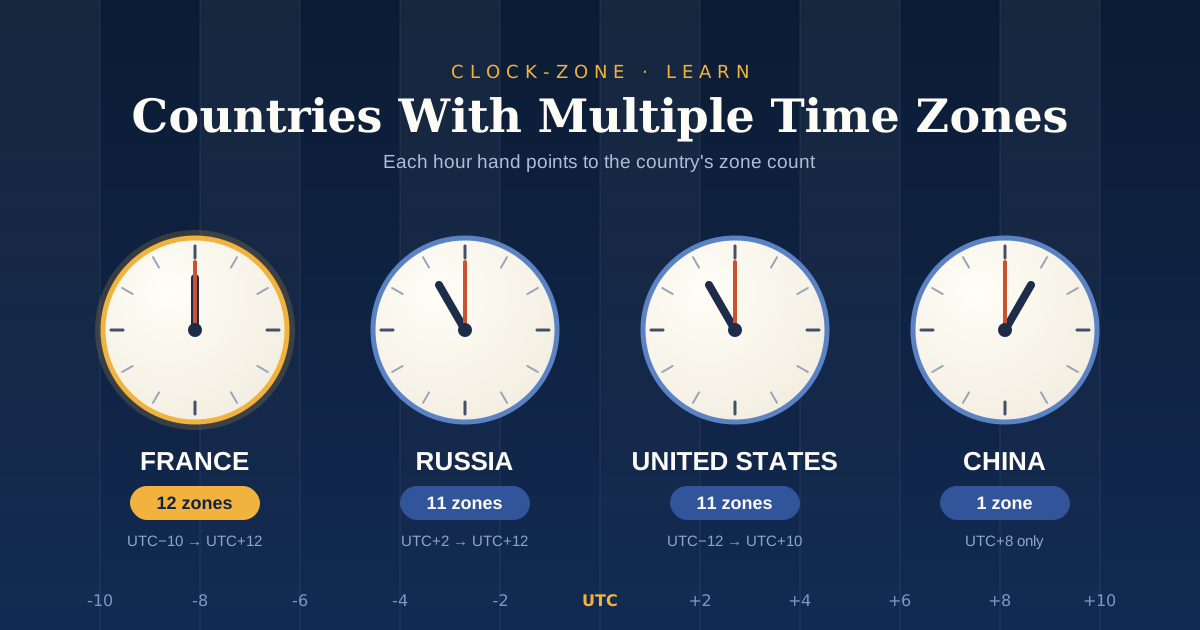
TL;DR: France has the most time zones of any country with 12 (13 counting its Antarctic claim), thanks to overseas territories scattered across every ocean. Russia and the US follow with 11 each, the UK spans about 9, and Australia's count balloons well past its 3 mainland zones once islands are added. Meanwhile, China squeezes five zones' worth of land into one. Here's the full ranked list and the stories behind it.
Here's a pub-quiz question that fools almost everyone: which country has the most time zones?
Most people guess Russia, the giant that stretches nearly halfway around the planet. Others say the United States or Canada. All good guesses, and all wrong. The answer is France, a country you can drive across in a day.
Countries with multiple time zones are stranger and more interesting than the world map suggests. Some earn their zones through sheer size, some through far-flung islands, and some huge nations refuse to have more than one clock at all. The counts also shift depending on who's counting, which is why you'll see France credited with 12 or 13 zones and the US with anywhere from 4 to 11.
In this guide, we'll rank the countries with the most time zones, unpack how each one got there, look at the giants that run on a single clock, and cover what all of this means when you're scheduling a call or booking a flight inside one of these countries.
Which Country Has the Most Time Zones?
France has the most time zones in the world: 12 in total, or 13 if you count its claim in Antarctica. Russia and the United States tie for second with 11 each. France wins not through size but through geography, with territories spanning from UTC-10 in French Polynesia all the way to UTC+12 in Wallis and Futuna.
Here's the leaderboard, counting each country's territories:
| Rank | Country | Time zones | The short version |
|---|---|---|---|
| 1 | France | 12 (13 with Antarctica) | Overseas territories in every ocean |
| 2 (tie) | Russia | 11 | One enormous contiguous landmass |
| 2 (tie) | United States | 11 | 6 across the states plus island territories |
| 4 | United Kingdom | ~9 | Overseas territories from Pitcairn to Diego Garcia |
| 5 | Australia | 8-9 | 3 mainland zones plus quirky islands |
| 6 | New Zealand | 5 | Includes the Chatham Islands at UTC+12:45 |
Why the wobbly numbers? Because rankings depend on counting rules. Lists differ on whether to include overseas territories, uninhabited islands, or Antarctic claims, which is how the US lands anywhere from 4 to 11. Every zone in the table is just an offset from the world's reference clock; if that idea is new, our guide to UTC offsets explains it in plain English.
Now for the stories behind the numbers, starting with the surprise champion.
Why Does France Have 12 Time Zones?
Mainland France, the hexagon on the map of Europe, uses exactly one time zone: Central European Time at UTC+1. The other 11 zones come entirely from its overseas departments and territories, remnants of empire scattered across the Caribbean, the Indian Ocean, the Pacific, and South America.
The spread is remarkable. French clocks run from Tahiti Time at UTC-10, through Martinique in the Caribbean and Réunion in the Indian Ocean, to New Caledonia and Wallis and Futuna in the Pacific at UTC+11 and UTC+12. When Parisians sit down to lunch, some French citizens are asleep in yesterday evening and others are already deep into tomorrow morning.
There's even a bonus zone. The tiny islands of Saint-Pierre and Miquelon, just off Canada, observe daylight saving, and when their clocks spring forward France temporarily counts a 13th local time. Add the French Antarctic claim and some lists say 13 year-round.
How Do Russia's 11 Time Zones Work?
Russia's 11 zones run from Kaliningrad at UTC+2 to Kamchatka at UTC+12, and unlike France, they're earned almost entirely by landmass. Ten of the 11 zones cover one continuous stretch of territory, a world record of its own; only the Kaliningrad exclave, wedged between Poland and Lithuania, sits apart.
The practical effects are wild. When it's noon in Moscow, it's already 9 PM in Vladivostok on the Pacific coast. A trans-Siberian train crosses seven time zones on one ticket, and national TV and airline schedules juggle the spread every single day.
Russia has also tinkered with the system more than most. The government consolidated some zones in 2010 and abolished daylight saving entirely in 2011, then restored an eleventh zone a few years later. Even for the country most defined by time zones, the map is a political document.
How Many Time Zones Does the United States Have?
The US is the rare country where four different answers are all correct, depending on what you count.
- 4 zones cover the contiguous states: Eastern, Central, Mountain, and Pacific.
- 6 zones cover all 50 states once you add Alaska and Hawaii.
- 9 zones is the official legal count, which adds inhabited territories like Puerto Rico (UTC-4), Guam (UTC+10), and American Samoa (UTC-11).
- 11 zones is the trivia answer, reached by including uninhabited outposts like Baker and Howland Islands at UTC-12, the last place on Earth to finish each day.
The US adds its own internal wrinkle: most of the country changes clocks twice a year, but Hawaii and most of Arizona don't observe daylight saving time. So the gap between Phoenix and New York is two hours in winter but three in summer, without Phoenix touching a single clock.
What About Other Countries With Multiple Time Zones?
Beyond the big three, several countries pack in more clocks than people expect, each with a signature quirk.
Canada: the proud half hour
Canada spans 6 time zones, from Pacific at UTC-8 to Newfoundland at UTC-3:30, covering four and a half hours coast to coast. That last one is the famous oddity: Newfoundland runs 30 minutes ahead of its Atlantic neighbors, a half-hour offset locals are genuinely proud of. It's why Canadian broadcasters say things like "at 8, 8:30 in Newfoundland."
Australia: home of the world's strangest clock changes
Mainland Australia uses three zones: Western at UTC+8, Central at UTC+9:30, and Eastern at UTC+10, and yes, one of them is a half-hour zone covering Adelaide and Darwin. Add external islands and DST variations and the count balloons to eight or nine offsets.
The crown jewel is Lord Howe Island, which runs at UTC+10:30 and moves its clocks by just 30 minutes for daylight saving, the only place on Earth with a half-hour DST shift. In summer it aligns perfectly with Sydney; in winter it floats 30 minutes ahead of nobody in particular.
Brazil, Mexico, and Indonesia
Brazil runs four zones, from UTC-2 on its Atlantic islands to UTC-5 in the far western Amazon, and scrapped daylight saving in 2019. It's also charmingly indecisive: the country cut its fourth zone in 2008, then brought it back in 2013 after public complaints.
Mexico also uses four zones and ended nationwide daylight saving in 2022, though some northern border cities still follow the US schedule to stay in sync with their neighbors. Indonesia stretches across three zones along more than 5,000 kilometers of equator, splitting Java, Bali, and Papua onto different clocks.
Why Do Some Huge Countries Use Just One Time Zone?
Here's the flip side of the ranking: some of the world's biggest countries deliberately run on a single clock.
China is the headline case. Despite being nearly as wide as the continental US, geography that would justify five zones, China has used one national time since 1949: Beijing Time, UTC+8. The choice was about national unity, and the cost is paid in the far west, where the official clock runs hours ahead of the sun and solar noon can land in mid-afternoon.
India made a similar call. Despite spanning enough longitude for two zones, the entire country runs on one time, IST at UTC+5:30, so sunrise in the northeast comes almost two hours before sunrise in the west on the same official clock.
The lesson of both: a country's zone count is a political choice as much as a geographic fact. If you want the full origin story of how the zone system came to exist at all, our guide on why time zones exist traces it from railroad chaos to the modern map.
What Do Multiple Time Zones Mean for Travelers and Teams?
The practical takeaway: never assume one country means one time. A domestic flight or call inside the US, Russia, Canada, Australia, or Brazil can cross two, three, or even seven zones, so always check both cities, not the country.
Internal DST patchworks make it trickier. Arizona sits out the clock changes its neighbors observe, Queensland skips the DST that Sydney follows, and most of Saskatchewan never changes at all. That means two cities in the same country can drift an hour apart and back over the course of a year. Our guide on how to convert time between time zones covers the six traps this creates.
We see this constantly at Clock-Zone: a huge share of lookups on our converter are domestic pairs, New York to Honolulu, Perth to Sydney, Moscow to Vladivostok. In-country differences catch people off guard precisely because they don't expect them. The time zone converter handles any two cities, half-hour zones and DST quirks included, right in your browser with no app or account.
Conclusion: A Map of History, Not Just Geography
So the rankings are settled: France leads with 12 time zones thanks to its ocean-spanning territories, Russia and the US follow with 11, and giants like China and India prove that a country can simply choose to have one. Zone counts turn out to be a map of empire, politics, and stubborn local pride as much as longitude. Somewhere on Earth right now, three different calendar days can even exist at the same moment.
Want to see it live? Open the world clock on Clock-Zone.com and line up Tahiti, Paris, and New Caledonia, all France, all hours apart. Bookmark the converter for your next cross-zone call, and go win that pub quiz.
Frequently Asked Questions
Which country has the most time zones?
France, with 12 time zones, or 13 if its Antarctic claim is counted. Metropolitan France uses just one zone (UTC+1); the rest come from overseas territories stretching from French Polynesia at UTC-10 to Wallis and Futuna at UTC+12. Russia and the United States tie for second with 11 each.
Does Russia or the US have more time zones?
They're usually tied at 11, but they get there differently. Russia's 11 zones sit almost entirely on one continuous landmass, from Kaliningrad (UTC+2) to Kamchatka (UTC+12). The US reaches 11 only by counting island territories and uninhabited outposts; its 50 states span 6 zones, and the official legal count is 9.
Why does China have only one time zone despite its size?
China adopted a single national time, Beijing Time (UTC+8), in 1949 to promote unity. Geographically the country spans about five zones, so in far western regions the official clock runs well ahead of the sun, with solar noon arriving in mid-afternoon. Many residents there informally keep a local time closer to solar reality.
What is the largest time difference within one country?
France holds the record: its territories span from UTC-10 to UTC+12, a spread of 22 hours (rising to 23 when Saint-Pierre and Miquelon observes DST). Among contiguous landmasses, Russia leads with a 10-hour spread, so noon in Moscow is already evening in Vladivostok.
Which countries have half-hour or 45-minute time zones?
India (UTC+5:30), central Australia (UTC+9:30), Canada's Newfoundland (UTC-3:30), and Iran and Myanmar use half-hour offsets. Nepal (UTC+5:45), New Zealand's Chatham Islands (UTC+12:45), and Australia's tiny Eucla region (UTC+8:45) use quarter-hour offsets. Australia's Lord Howe Island adds the world's only 30-minute daylight saving shift.
Related Guides
- World Clock: How to Check the Current Time in Any City — check every zone on this list live, side by side.
- Daylight Saving Time Senate Debate — for countries on this list still juggling seasonal clock changes.
- Why Do Time Zones Exist? — the railroad history behind why the map looks this uneven.