Why Do Time Zones Exist?
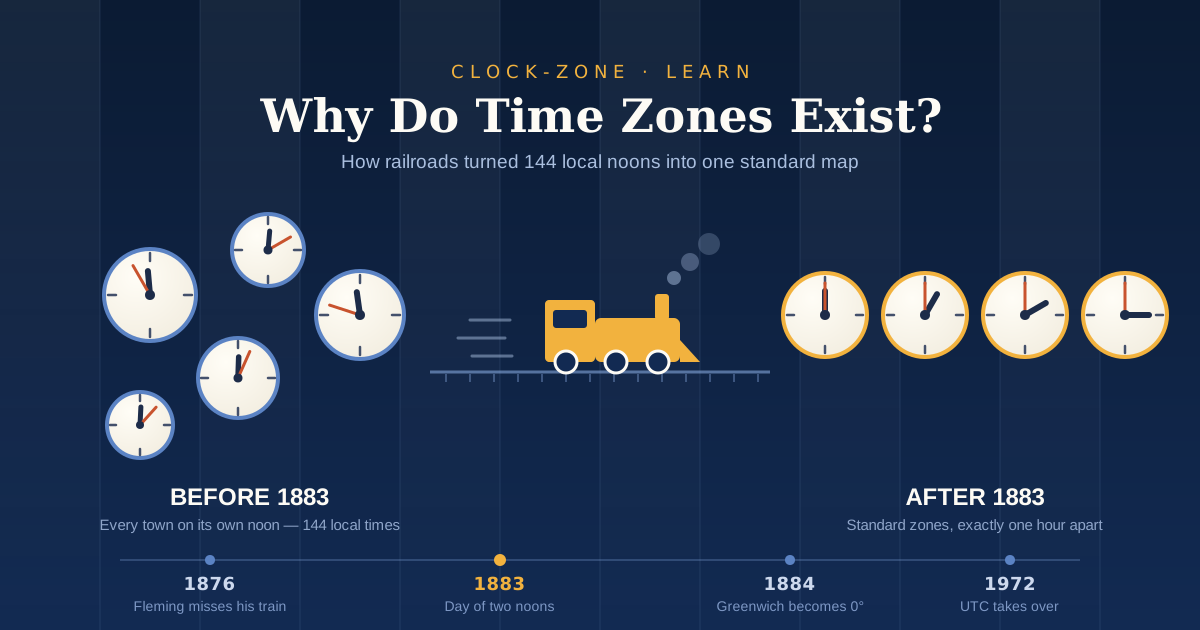
TL;DR: Time zones exist because railroads and telegraphs made the old system of sun-based local time unworkable. Before 1883, North America alone ran on more than 144 local times, with every town setting its clock by its own noon. Railroads created four standard zones, an 1884 conference made Greenwich the world's reference point, and today every zone is an offset from UTC. Politics has been bending the map into strange shapes ever since.
In 1876, a Canadian railway engineer named Sandford Fleming missed a train because of a timetable mix-up. Most of us would grumble and wait for the next one. Fleming decided to fix how the entire planet tells time.
His frustration answers the question of why time zones exist better than any textbook. Time zones weren't handed down by nature. They were invented, barely 140 years ago, because the world suddenly started moving faster than its clocks could handle. Before that, every town on Earth kept its own private time, and nobody minded.
So what changed? Trains, telegraphs, and one very chaotic century.
In this guide, we'll walk through what timekeeping looked like before zones, the railroad emergency that forced the change, the conference that gave us the map we use today, and why that map is full of gloriously weird exceptions, from a country that's 14 hours ahead of the reference clock to a nation of 1.4 billion people running on a single time.
Why Do Time Zones Exist?
Time zones exist because fast travel and instant communication made sun-based local time unworkable. Once trains and telegraphs connected distant cities, thousands of slightly different local clocks caused missed connections, scheduling chaos, and even collisions. Standard zones fixed this by letting whole regions share one agreed clock, defined as an offset from a single global reference.
The underlying idea is simple geometry. Earth rotates 360 degrees in 24 hours, which works out to 15 degrees of longitude per hour. Divide the planet into 24 slices of 15 degrees each, give every slice one shared time, and neighbors agree on the clock while distant regions differ by neat whole hours.
Today each zone is expressed as an offset from UTC, the atomic-clock standard at the prime meridian. New York is UTC-5, Delhi is UTC+5:30, Tokyo is UTC+9. If you want the full story of the reference clock itself, our guide to what UTC time is covers it in plain English.
But that tidy 24-slice model came late. For most of human history, time worked very differently.
What Did the World Do Before Time Zones?
Before standard time, every community kept solar time. Noon was simply the moment the sun stood highest over your own town, and a trusted public clock, often on a church steeple or in a jeweler's window, kept everyone loosely in sync.
This meant clocks drifted continuously as you traveled. Move a few dozen miles east or west and local noon shifted by minutes. Boston, Providence, and New York each ran a few minutes apart, and none of them were "wrong." By the 1880s, North America alone was running on more than 144 different local times.
For centuries, this was completely fine. When the fastest thing in your life is a horse, a twelve-minute difference between towns is invisible. Then two inventions broke the system at once: the telegraph, which let messages cross the continent instantly, and the railroad, which let people follow them at unheard-of speed. Suddenly all those private noons had to talk to each other, and they couldn't.
How Did Railroads Create the First Time Zones?
At noon on November 18, 1883, North American railroads divided the continent into four standard time zones and reset their operations to match. The day became known as the "day of two noons," because towns east of each new zone meridian saw their clocks strike noon twice: once on local sun time, and again when the new standard caught up.
The railroads acted because the old system had become dangerous, not just inconvenient. Timetables in major cities listed dozens of different arrival and departure times for the same train, each pegged to a different local clock. On single-track lines, where trains ran toward each other and relied on timing to pass safely, a few minutes of disagreement between company clocks was a recipe for disaster.
From railway rule to national law
Notably, no government ordered this. The railroad companies simply agreed among themselves and switched, and the public followed because train time was the time that mattered. Adoption wasn't instant: some skeptical towns displayed both local time and railway time side by side for years. The arrangement only became official law decades later, when the Standard Time Act of 1918 wrote the zones into US legislation.
One continent was sorted. The rest of the planet still needed a plan.
Who Invented the Worldwide Time Zone System?
This is where our train-missing engineer returns. After his 1876 timetable mishap, Sandford Fleming began campaigning for a worldwide standard time, proposing a global system of 24 hourly zones tied to one reference meridian. He presented the idea at conference after conference until governments took notice.
The breakthrough came in 1884, when Fleming helped convene the International Prime Meridian Conference in Washington, DC. Delegates from more than 20 countries gathered and, after plenty of tugging and pulling, reached agreement: the meridian running through Greenwich, England would be zero degrees longitude, the line every zone on Earth is measured from.
Greenwich Mean Time served as that reference for decades. In 1972 the atomic-clock standard UTC took over the job, and clock changes for daylight saving time added a seasonal wrinkle on top. But the basic architecture agreed in 1884, one reference point and hourly offsets around the globe, is exactly the system your phone uses right now.
At least, that was the blueprint. Then politics got hold of the map.
Why Don't Time Zones Follow Neat Straight Lines?
Time zones ignore the tidy 15-degree slices because they're political creations, not geographic ones. Countries bend zone borders for national unity, trade relationships, and daily convenience. That's why real offsets run all the way from UTC-12 to UTC+14 and include half-hour and even quarter-hour zones.
Look at a time zone map and you'll see the theory buckle everywhere. Russia spreads across 11 zones, while China and India each use just one. Here are the most famous oddities.
China: one clock for 1.4 billion people
China is wide enough for five geographic zones, but since 1949 the whole country has run on Beijing Time, UTC+8, largely as a statement of national unity. The result in the far west is surreal: solar noon can arrive around 3 PM, and winter sunrises come as late as 10 AM. Many locals in Xinjiang informally keep a second, unofficial time closer to the sun.
Nepal: the 15-minute statement
India runs at UTC+5:30, one of the world's half-hour zones. Nepal went finer still: its UTC+5:45 offset follows the meridian of a mountain peak east of Kathmandu rather than rounding to a neighbor's time. Cross the India-Nepal border and your watch moves 15 minutes.
Kiribati: the country that moved the date line
Until 1995, the International Date Line sliced the Pacific nation of Kiribati in half, so the country's east and west lived on different calendar days. Kiribati fixed it by shoving the date line eastward around itself, creating the UTC+14 zone and becoming the first country to greet the year 2000. UTC+14 remains the earliest time zone on Earth, always first into each new day.
Samoa: the country that deleted a day
Samoa pulled the boldest move of all. To align its week with trading partners Australia and New Zealand, it jumped across the date line at the end of December 29, 2011, going straight from the 29th to the 31st. For everyone in Samoa, December 30, 2011 simply never happened.
The date line itself zigzags wildly around islands and borders for exactly these reasons. Time zones, it turns out, are less a map of the sun and more a map of human decisions.
What Do Time Zones Mean for You Today?
For daily life, time zones mean one thing: any time you coordinate across borders, you're navigating a system built from history and politics, not logic. The practical answer isn't to memorize the map. It's to know your own UTC offset and let live tools handle everyone else's.
The quirks above aren't just trivia; they're active scheduling traps. Fractional offsets break mental math, daylight saving time shifts offsets seasonally in some countries but not others, and governments still redraw zone rules with little warning. Our guide on how to convert time between time zones covers the six mistakes these quirks cause and how to dodge each one.
This is exactly why we built Clock-Zone the way we did. The time zone converter applies the real, current rules for any two places, including the +5:45s and the UTC+14s, right in your browser with no app and no account. Fleming had to reorganize the planet to catch his train. You just need one tab.
Conclusion: A Map Drawn by Trains and Politics
So why do time zones exist? Because in the 1880s, the world started moving faster than a thousand private noons could handle. Railroads forced the first standard zones in 1883, the Greenwich conference of 1884 gave the planet a single reference point, and UTC now anchors the whole system with atomic precision. Everything strange about today's map, from Beijing Time to Kiribati's date-line detour, is a human choice layered on that foundation.
Next time you glance at a meeting invite in another zone, you're looking at 140 years of engineering and diplomacy. See it live: open the world clock on Clock-Zone.com and watch the whole odd, brilliant system tick in real time. Bookmark it, and share this story with the friend who thinks time zones are boring.
Frequently Asked Questions
When were time zones invented?
North American railroads introduced the first standard time zones on November 18, 1883, replacing more than a hundred local sun-based times. The following year, the 1884 International Meridian Conference in Washington, DC established Greenwich as zero degrees longitude, creating the framework for worldwide zones. The US made its zones official law with the Standard Time Act of 1918.
Why are there 24 time zones, and are there really only 24?
The classic model divides Earth's 360 degrees by 24 hours, giving 24 zones of 15 degrees each. In practice there are more, because some regions use half-hour offsets (India at UTC+5:30) or quarter-hour offsets (Nepal at UTC+5:45), and offsets extend to UTC+14. Counting every distinct offset in use, the real number is closer to 40 than 24.
Why does China only have one time zone?
China has used a single national time, Beijing Time (UTC+8), since 1949, mainly to promote national unity. Geographically the country spans about five zones, so in far western regions the official clock runs hours ahead of the sun, with winter sunrises near 10 AM. Many residents there informally follow a local time closer to solar reality.
What is the International Date Line?
It's the imaginary line, roughly along 180 degrees longitude, where the calendar date changes. Cross it heading west and you skip forward a day; cross it heading east and you repeat one. The line zigzags around countries and island groups so that no nation is split across two calendar days.
Which country is first to start each new day?
Kiribati, in the central Pacific. After moving the date line around itself in 1995, its Line Islands sit in UTC+14, the earliest time zone on Earth. That made Kiribati the first country to enter the year 2000, and it remains first into every new day and new year.
Related Guides
- Countries With Multiple Time Zones — how France ended up with 12, and why China runs on just one.
- What Is UTC Time? — the modern successor to the Greenwich reference point this history is built on.
- World Clock: How to Check the Current Time in Any City — put the history to use and check any zone live.