How to Convert Time Between Time Zones Without Mistakes
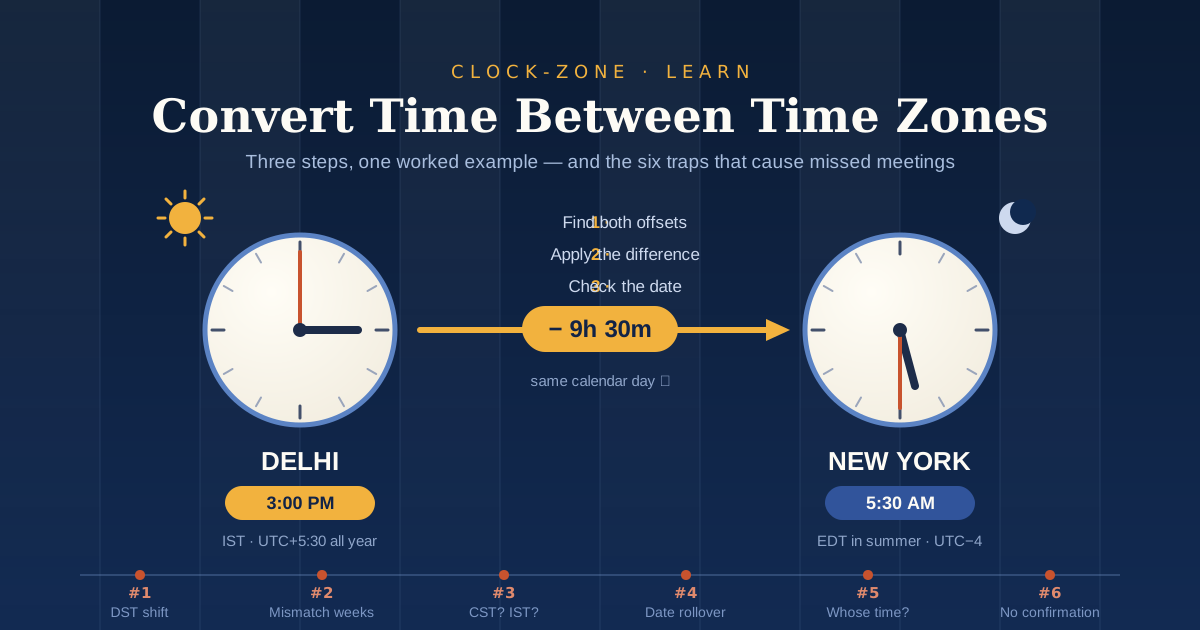
TL;DR: Converting time between time zones is simple math that goes wrong in predictable ways: stale daylight saving offsets, ambiguous abbreviations like CST and IST, forgotten date rollovers, and "your time or my time" confusion. This guide gives you a reliable three-step conversion method, the six mistakes behind almost every missed meeting, and a quick checklist to verify any converted time. Or skip the math entirely with a free browser-based converter.
"The meeting is at 3 PM."
Five little words that have made millions of people show up an hour early, an hour late, or on the entirely wrong day. If you've ever needed to convert time between time zones for a client call, a job interview, or a flight, you know the quiet panic: is it 3 PM their time or mine? Is daylight saving on right now? Did the date just flip?
Here's the good news. Time zone mistakes aren't random. Nearly all of them come from the same six errors, and every one of them is preventable once you know what to look for.
We see this daily at Clock-Zone. People don't reach for our time zone converter because the math is hard. They reach for it because doing offset math in your head, under pressure, at 11 PM before an interview, is exactly when mistakes happen.
In this guide, you'll learn a three-step method that always works, the six mistakes to avoid, and a 10-second checklist to run before you hit send on any meeting invite.
How Do You Convert Time Between Time Zones Correctly?
To convert time between time zones, follow three steps. First, find the current UTC offset of both zones, including any daylight saving adjustment. Second, work out the difference between the two offsets. Third, apply that difference to your starting time and check whether the result lands on a different date.
Every time zone on Earth is defined as an offset from UTC, the world's reference clock. New York is UTC-5 in winter. Delhi is UTC+5:30 all year. If offsets are new to you, our guide on what UTC time is explains the whole system in plain English.
A worked example: Delhi to New York
Say it's 3:00 PM in Delhi in July, and you need New York time.
- Find both offsets. Delhi is UTC+5:30. New York in July observes daylight saving, so it's UTC-4.
- Find the difference. From +5:30 down to -4 is a gap of 9 hours 30 minutes. New York is behind, so you'll subtract.
- Apply and check the date. 3:00 PM minus 9:30 is 5:30 AM. Same calendar day, so you're done. Your 3 PM in Delhi is 5:30 AM in New York.
That's the entire method. The six mistakes below are the ways each step quietly goes wrong.
Mistake #1: Ignoring Daylight Saving Time
Daylight saving time (DST) is the single biggest cause of conversion errors, because it changes a zone's UTC offset for part of the year. A time difference you memorized in January can be wrong in July. When DST is active, a region moves one hour closer to UTC, so New York shifts from UTC-5 to UTC-4 and London from UTC+0 to UTC+1.
The scale of this is huge. Roughly 1.6 billion people across 70+ countries move their clocks twice a year. Meanwhile, most of Asia and Africa never touch theirs. India, China, and Japan stay on the same offset all year.
Why "fixed" time differences aren't fixed
This mix creates a moving target. Delhi to New York is a 10:30 gap in winter but only 9:30 in summer, because New York shifted and Delhi didn't. If you saved "New York is 10.5 hours behind me" as a permanent fact, you'll be an hour off for eight months of the year. Always check the offset for the specific date of your event, not the offset you remember.
Mistake #2: Forgetting the DST Mismatch Weeks
Here's the trap that catches even careful people: regions that both observe DST don't switch on the same weekend. For a few weeks each year, familiar time differences silently change, then change back.
The 2026 danger windows
In 2026, the US springs forward on March 8, but Europe doesn't switch until March 29. For those three weeks, the New York to London difference drops from the usual 5 hours to just 4. A weekly call that's always been "2 PM New York, 7 PM London" temporarily becomes 2 PM and 6 PM. If nobody updates the invite, someone shows up an hour off.
The same thing happens in reverse each autumn. Europe falls back on October 25, 2026, while the US waits until November 1, creating a one-week mismatch. Europe's DST period is three to four weeks shorter than America's every single year, so these windows aren't a fluke; they're the calendar.
During March-April and October-November, treat every recurring cross-border meeting as suspect. A quick glance at the world clock showing both cities side by side settles it in seconds.
Mistake #3: Trusting Ambiguous Abbreviations Like CST and IST
Time zone abbreviations look precise, but many of them point to two or three completely different zones. CST can mean North American Central Time (UTC-6), China Standard Time (UTC+8), or Cuba Standard Time (UTC-5). The fix: never rely on an abbreviation alone. Pair every time with a city name or a UTC offset.
Think about what that CST confusion means in practice. A Dallas reader and a Shanghai reader see the same "3 PM CST" and picture moments 14 hours apart. IST is just as bad, covering India (UTC+5:30), Ireland (UTC+1), and Israel (UTC+2), a spread of four and a half hours behind three identical letters.
The EST-in-summer problem
There's a subtler version of this mistake too. Many people write "EST" all year, but for half the year the US East Coast is actually on EDT, one hour ahead of EST. An invite that says "3 PM EST" in July technically points to 4 PM local New York time. Most readers will guess what you meant, but "3 PM New York time" never needs guessing.
Simple habit: write the city, not the code. "14:00 London" beats "2 PM GMT" every time.
Mistake #4: Missing the Date Change
Time zone conversions don't just move the clock. They can move the calendar, and a meeting on the wrong day is worse than a meeting at the wrong hour.
Any conversion that crosses midnight lands on a different date. A 9:00 AM Monday call in Los Angeles is 1:00 AM Tuesday in Tokyo. Going the other way, 02:00 UTC on March 10 is still the evening of March 9 in US Eastern time. If you only convert the hours and never glance at the day, you can book a flight, a call, or a deadline 24 hours off.
Half-hour offsets make it trickier
Mental math gets harder when offsets aren't whole hours. India runs at UTC+5:30, and Nepal uses UTC+5:45, one of the rare quarter-hour zones. Crossing from a +5:30 zone to a -4 zone at 11 PM is exactly the kind of arithmetic where a date slips by unnoticed. Our free time calculator handles the adding and subtracting for you, minutes included.
Rule of thumb: whenever your start time is within 10 hours of midnight, in either direction, double-check the weekday of the result.
Mistake #5 and #6: "Whose Time?" Confusion and Skipping the Confirmation
The last two mistakes aren't about math at all. They're about communication, and they cause just as many missed calls.
Mistake #5: Not saying whose time it is
"Let's meet Thursday at 2 PM." Whose 2 PM? Leaving out the time zone is one of the most common scheduling errors, because each side quietly assumes their own clock. For international groups, one clean fix is to state the time once in UTC and let everyone convert to their local time from there.
One more UK-specific trap: don't label a London meeting as "GMT" in summer. The UK runs one hour ahead of GMT during British Summer Time, so "3 PM GMT" and "3 PM London time" are different moments from late March to late October. Name the city instead.
Mistake #6: Never confirming in both local times
Even a perfect conversion helps nobody if the other person did their own math and got a different answer. Close the loop with one line: "That's 9:30 AM your time in Chicago, 8:00 PM mine in Delhi. Correct?" Ten words, and any error surfaces a day early instead of five minutes late. A calendar invite works as a second safety net, since it displays the event in each attendee's own zone automatically.
How Can You Convert Time Zones Without Doing Any Math?
The most reliable way to convert time between time zones is to use a converter that applies live daylight saving rules for the exact date of your event. You enter the time and both locations, and the tool returns the correct local time, DST and date changes included, with nothing to memorize.
That's precisely why we built the free time zone converter at Clock-Zone. It runs in your browser on any device, needs no app or account, and handles the half-hour offsets and seasonal shifts that break mental math. Pair it with the world clock to watch multiple cities at once before you pick a meeting slot.
The 10-second pre-send checklist
Before any cross-zone invite goes out, run through this:
- City named? Every time is paired with a city, not just an abbreviation.
- DST checked? The offset matches the event's date, not today's.
- Mismatch window? If it's March-April or October-November, you've verified the current difference.
- Date verified? The converted time didn't slip into yesterday or tomorrow.
- Confirmed both ways? The other person has seen the time in their own zone.
Five checks, ten seconds, zero missed meetings.
Conclusion: Convert Once, Verify Twice
Time zone mistakes feel embarrassing, but they're not a personal failing. They're the natural result of a system with shifting offsets, duplicate abbreviations, and midnight boundaries. The cure is a routine: find both current offsets, apply the difference, check the date, and confirm in both local times.
Or let the tools carry the load. Open the time zone converter on Clock-Zone.com, type in your time and both cities, and get an answer that already accounts for daylight saving and date changes. It's free, browser-based, and works on your phone as easily as your desktop.
Bookmark it, share it with the colleague who keeps sending "3 PM CST" invites, and never do panicked timezone math again.
Frequently Asked Questions
What is the easiest way to convert time between time zones?
Use a converter tool that applies live daylight saving rules: enter your time and both cities, and read the result. If you prefer doing it manually, find both zones' current UTC offsets, apply the difference, and check whether the result lands on a different date.
Why do time zone conversions change during the year?
Because many regions observe daylight saving time, which shifts their UTC offset by one hour for part of the year. Since regions switch on different dates (the US on March 8, 2026, Europe on March 29, 2026), the difference between two cities can temporarily change for a few weeks in spring and autumn.
What does "3 PM EST" mean if it's summer?
Technically, EST is always UTC-5, but the US East Coast runs on EDT (UTC-4) during summer. Most people who write "EST" in July actually mean current New York local time. To be safe, confirm with the sender or treat it as Eastern Time for that date, and write city names instead of abbreviations in your own invites.
How do I convert a time that crosses midnight?
Apply the offset difference as usual, then adjust the date. If subtracting hours takes you past 12:00 AM, the result is the previous day; if adding pushes you past midnight, it's the next day. Always state the weekday along with the time, such as "1:00 AM Tuesday in Tokyo."
Should I use UTC for scheduling international meetings?
For groups spanning three or more zones, yes. Stating one time in UTC gives everyone a single unambiguous reference, and each person converts to their own local time. UTC never observes daylight saving, so the reference itself never shifts. For one-on-one meetings, naming both cities' local times works just as well.
Related Guides
- What Is UTC Time? — the reference point every conversion is really measured against.
- Why Do Time Zones Exist? — the railroad history and odd map lines behind the offsets.
- World Clock: How to Check the Current Time in Any City — a faster check than converting by hand.