What Is UTC Time? A Beginner's Guide
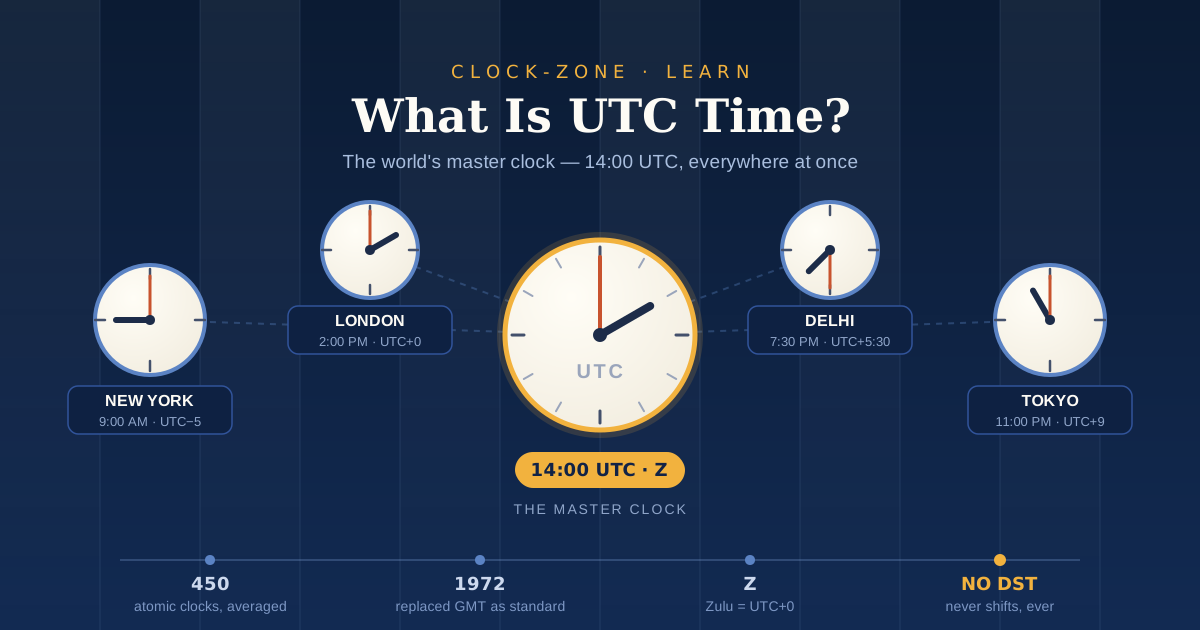
TL;DR: UTC (Coordinated Universal Time) is the world's master clock. Every time zone on Earth is defined as an offset from it, like UTC+5:30 for India or UTC-5 for New York. It's kept by hundreds of atomic clocks, never shifts for daylight saving, and quietly powers aviation, the internet, and global scheduling. This guide explains what UTC is, how it works, and how to convert it to your local time in seconds.
You've probably seen it before. A webinar invite says "starts at 14:00 UTC." A game update drops at "18:00 UTC." A flight briefing mentions "0300Z." And you're left wondering: what time is that for me?
You're not alone. UTC time confuses millions of people every day, yet the idea behind it is surprisingly simple. UTC is just one shared clock that the whole world agrees on. Once you know your own offset from it, you can read any UTC time as easily as your kitchen clock.
We built Clock-Zone around this exact problem. Our free world clock shows the current time in cities worldwide right in your browser, no app or sign-up needed. But knowing how UTC works makes you faster than any tool.
In this guide, you'll learn what UTC stands for, how atomic clocks keep it accurate, how it differs from GMT, and how to convert it to your local time without breaking a sweat. Let's decode the world's clock.
What Is UTC Time?
UTC, short for Coordinated Universal Time, is the primary time standard the world uses to regulate clocks. It's not a time zone you live in. It's the single reference point that every time zone on Earth is measured from, expressed as an offset like UTC+2 or UTC-7.
Think of UTC as the "zero point" on a giant number line of time. New York sits at UTC-5 in winter. London sits at UTC+0. Delhi sits at UTC+5:30. Tokyo sits at UTC+9. When everyone measures from the same zero, a meeting set for "15:00 UTC" means one exact moment, everywhere on the planet.
The time shown by UTC matches the time at the prime meridian, the line of 0° longitude that passes near Greenwich, England. That's the same line the older GMT standard was built on, which is why the two often get mixed up (more on that below).
Why is it called UTC and not CUT?
Here's a fun bit of trivia. The English name would shorten to CUT, and the French name (Temps Universel Coordonné) would shorten to TUC. Neither side wanted to lose, so the compromise was UTC, which matches neither language perfectly and both equally. It also fits neatly alongside other "UT" time scales scientists use.
How Does UTC Actually Work?
UTC is calculated from a network of roughly 450 atomic clocks kept in about 85 national laboratories around the world. The International Bureau of Weights and Measures (BIPM) in France averages their readings into one super-accurate time scale. No single clock "is" UTC; it's a carefully weighted team effort.
Atomic clocks measure time using the vibrations of atoms, which are far steadier than the spinning Earth. The raw average of all those clocks is called International Atomic Time (TAI). UTC is then produced by taking TAI and adjusting it with leap seconds so it stays in step with the Earth's actual rotation.
What's a leap second?
Earth is a slightly sloppy timekeeper. Its rotation speeds up and slows down in tiny, unpredictable ways. When atomic time and "Earth rotation time" drift too far apart, an extra second gets added to UTC. Since 1972, 27 leap seconds have been added, always on June 30 or December 31.
Leap seconds cause headaches for computer systems, though. That's why the world's measurement authorities voted in 2022 to retire them by 2035, letting UTC run on pure atomic time. For everyday life, you'll never notice the difference.
One thing UTC never does: daylight saving
This is the detail beginners miss most often. UTC is never adjusted for daylight saving time. Your local clock may jump an hour twice a year, but UTC ticks straight through. That's exactly why global systems trust it: it has no jumps, no repeats, and no skipped hours, ever.
UTC vs GMT: What's the Difference?
For everyday purposes, UTC and GMT show the same time. The difference is what's underneath.
GMT (Greenwich Mean Time) is the older standard. It was based on the sun's position over the Royal Observatory in Greenwich, London. That worked fine until atomic clocks revealed the Earth's rotation isn't perfectly steady. UTC formally replaced GMT as the international standard in 1972, swapping astronomy for atomic precision.
A quick side-by-side
| GMT | UTC | |
|---|---|---|
| What it is | A time zone (and a historic standard) | The global time standard |
| Based on | The sun's position at Greenwich | Atomic clocks worldwide |
| Adjusts for DST? | The UK switches to BST in summer, but GMT itself is UTC+0 | Never |
| Used by | UK and some African countries as a local zone | Aviation, science, computing, global scheduling |
So when someone says "the call is at 3 PM GMT," they almost always mean 3 PM UTC. Just remember one trap: the UK itself moves to British Summer Time (UTC+1) from late March to late October. A Londoner's local time isn't always UTC+0, even though GMT is.
How Do You Convert UTC Time to Your Local Time?
To convert UTC to your local time, add or subtract your time zone's offset. If you're in India (UTC+5:30), add 5 hours 30 minutes: 14:00 UTC becomes 7:30 PM IST. If you're in New York during winter (UTC-5), subtract 5 hours: 14:00 UTC becomes 9:00 AM EST.
That's the whole trick. Every time zone is just UTC plus or minus a fixed number. Most offsets are whole hours, but some aren't. India runs at UTC+5:30, and Nepal uses the unusual offset of UTC+5:45.
Worked examples: 14:00 UTC around the world
Say a product launch is set for 14:00 UTC. Here's what that means in four major cities:
- London (UTC+0 in winter, UTC+1 in summer): 2:00 PM in winter, 3:00 PM in summer.
- New York (UTC-5 in winter, UTC-4 in summer): 9:00 AM in winter, 10:00 AM in summer.
- Delhi (UTC+5:30 all year): 7:30 PM, every day of the year. India skips daylight saving entirely.
- Tokyo (UTC+9 all year): 11:00 PM.
Rather than memorize offsets, you can use our free time zone converter to translate any UTC time into your city instantly. It runs in your browser and handles the fiddly half-hour offsets for you.
Watch out for these two traps
The daylight saving trap. Your offset can change with the seasons even though UTC doesn't. A Houston resident subtracts 6 hours in winter but only 5 in summer, because Central Time shifts from UTC-6 to UTC-5. Always check whether DST is active where you are.
The date trap. Conversions can cross midnight. For example, 02:00 UTC on March 10 is still the evening of March 9 in US Eastern time. If a UTC event lands near the start or end of a day, double-check which date it falls on for you.
Why Do Pilots, Programmers, and Global Teams All Use UTC?
Once you notice UTC, you'll see it everywhere. That's because any system that crosses time zones needs one clock nobody argues about.
Aviation runs on "Zulu time"
Pilots and air traffic controllers call UTC "Zulu time." A flight from New York to London crosses five time zones and talks to control centers in several countries. Flight plans, clearances, and weather reports all use UTC so every party reads the same moment, no conversion needed. Many pilots keep one cockpit clock permanently set to Zulu.
Computers store time in UTC
Servers, databases, and apps almost always record timestamps in UTC, then convert to your local time only when displaying it. The Network Time Protocol that keeps your phone and laptop synced pulls UTC from atomic-clock time servers, and GPS satellites each carry atomic clocks of their own. Without UTC, logs from machines in different countries would be impossible to line up.
Remote teams schedule with it
If your team spans Bangalore, Berlin, and Boston, "10 AM" means three different things. Stating a meeting in UTC (or sharing a link that shows current time in cities worldwide) removes the guesswork. One shared reference beats three private assumptions every time.
How Do You Read UTC Formats Like "14:30Z" or ISO 8601?
The letter Z after a time means UTC+0, so 14:30Z is simply 14:30 UTC. The Z stands for "Zulu," the NATO phonetic alphabet word for the letter Z, which labels the zero-offset zone. A full timestamp like 2026-07-08T14:30:00Z means July 8, 2026 at 14:30 UTC.
That long format is called ISO 8601, the international standard for writing dates and times. It always runs from biggest unit to smallest: year, month, day, then time. Under the standard, a time in UTC gets a Z attached directly after it, so "09:30 UTC" becomes "09:30Z".
Reading offsets in timestamps
Not every timestamp ends in Z. Some show a numeric offset instead:
- 2026-07-08T14:30:00Z means 14:30 UTC.
- 2026-07-08T20:00:00+05:30 means 8:00 PM in India, which is the same moment as 14:30 UTC.
- 2026-07-08T10:30:00-04:00 means 10:30 AM in US Eastern Daylight Time, again the same moment.
The offset tells you how far that local time sits from UTC. All three lines above describe one single instant. Once you can spot the Z or the offset, no timestamp will ever confuse you again.
Conclusion: One Clock for the Whole World
Here's what to remember. UTC is the world's shared reference clock, kept by atomic precision and immune to daylight saving chaos. Every time zone is just an offset from it. And converting is simple: know your offset, add or subtract, and mind the DST and date traps.
The next time an event is announced in UTC, you won't need to guess. Open our free time zone converter, or check the world clock, alarm, timer, and stopwatch on Clock-Zone.com. Everything runs in your browser with no downloads and no sign-ups, because checking the time should never cost you time.
Bookmark it, share it with your team, and never miss a "14:00 UTC" again.
Frequently Asked Questions
Is UTC the same as GMT?
For everyday use, yes, they show the same time. Technically they're different: GMT is based on the sun's position at Greenwich and now serves as a regional time zone, while UTC is the atomic-clock standard that replaced GMT internationally in 1972. In precise or technical contexts, UTC is the correct term.
What does the "Z" mean in UTC time?
The Z marks a time as UTC+0, so 14:30Z equals 14:30 UTC. It comes from "Zulu," the NATO phonetic word for the letter Z, which designates the zero-offset zone. Aviation, the military, and software timestamps all use it.
Does UTC change for daylight saving time?
No, never. UTC ticks at a constant rate all year. Local zones shift around it instead: New York moves from UTC-5 to UTC-4 in summer, while UTC itself stays put. That stability is exactly why global systems rely on it.
How do I find my time zone's UTC offset?
Check the current time in your city against UTC and note the difference, or look up your zone's standard abbreviation. The fastest way is a converter tool: enter UTC and your city, and the offset math is done for you, including any daylight saving adjustment.
Why is it called UTC instead of CUT?
The English abbreviation would be CUT and the French one would be TUC. As a compromise between the two languages, the international community settled on UTC, which favors neither and also matches the naming pattern of related time scales like UT1.
Related Guides
- How to Convert Time Between Time Zones Without Mistakes — the 3-step method and the 6 mistakes that cause missed meetings.
- Why Do Time Zones Exist? — the railroad history behind the offsets you're converting.
- World Clock: How to Check the Current Time in Any City — reading UTC offsets against a live world clock.