Study Timer: How to Use One (And How Long)
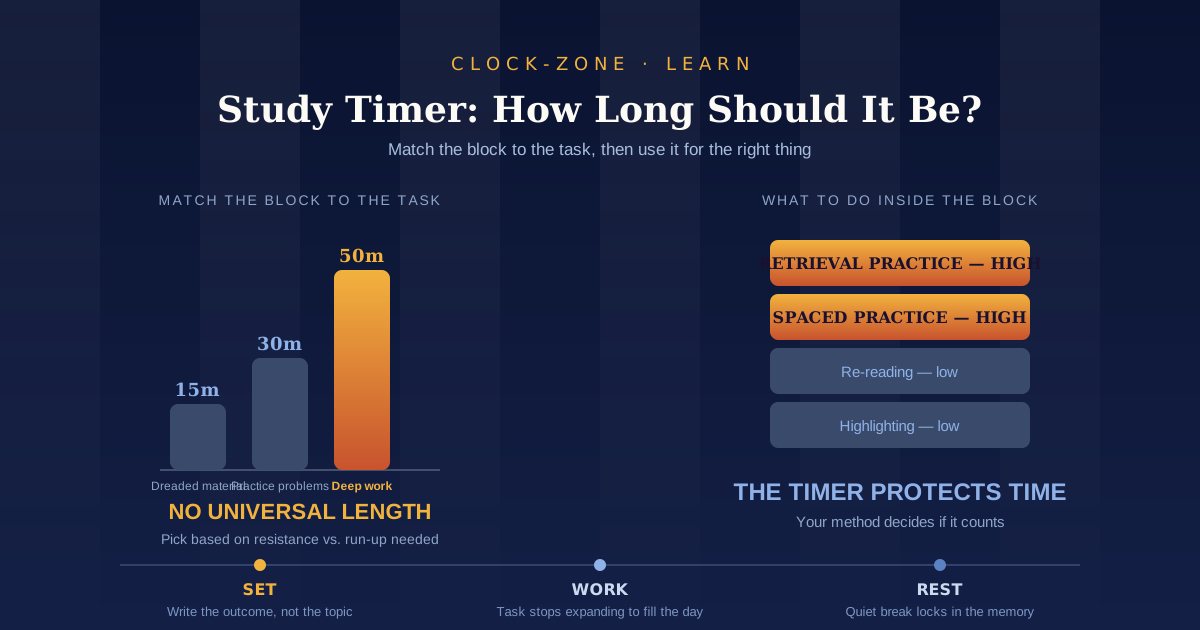
TL;DR: A study timer is any countdown that fences off a fixed block of focused study. It works by making starting easier, capping how long a task can expand, and forcing recovery before fatigue builds. There's no universal best length: 25 minutes suits resistance, 45 to 50 suits deep work. What you do inside the block matters more than the number on it.
You know the afternoon. You sat down at two, you got up at six, and if someone asked what you actually learned you'd struggle to answer. Four hours logged. Almost nothing retained.
That gap between hours spent and work done is the problem a study timer solves. Not by making you work harder, but by turning a shapeless afternoon into a series of small, finite commitments you can actually finish.
This guide covers whether timers genuinely help, how long your blocks should be (the honest answer is more useful than the usual one), five methods worth trying, and the part most articles skip entirely: what should be happening inside the block. Because a timer protects the time. It doesn't decide whether that time was worth anything.
What Is a Study Timer?
A study timer is a countdown that fences off a fixed block of focused study, usually followed by a short break. It can be a kitchen timer, a phone, or a browser tab. Its purpose isn't to measure how long you studied but to set a boundary before you start, so the session has an end.
That distinction matters more than it sounds.
A countdown limits. You set 30 minutes, and at zero you stop. A stopwatch measures. You start it, work, and see how long you lasted. Both are useful for studying, but for different methods, and we'll get to that.
The important thing is that a study timer is a commitment device, not a productivity gadget. You're making a small promise to your future self: for these 30 minutes, this one thing. The value comes from the boundary, not from the ticking.
Why Does Studying With a Timer Actually Work?
A study timer works through four mechanisms: it lowers the barrier to starting because a fixed block feels small, it stops the task expanding to fill your whole evening, it makes the break non-negotiable rather than a decision, and it converts a vague intention into a specific plan.
Take those one at a time.
Starting gets cheaper. "Revise chapter seven" is an unbounded commitment and your brain treats it accordingly. "Thirty minutes on chapter seven" is a thing with an end. You're not agreeing to finish, only to begin.
Work stops expanding. In 1955 the naval historian Cyril Northcote Parkinson observed that work expands so as to fill the time available for its completion, and anyone who has spent an entire Sunday on a task that needed ninety minutes has lived it. A timer is the direct counter: capping the duration before you begin prevents the task ballooning, and it removes the constant micro-decisions about whether to keep going.
Breaks become part of the method. This one is genuinely underrated. In a well-known experiment, participants who spent ten minutes resting quietly after learning a story remembered significantly more of it, both shortly afterwards and seven days later, compared to those who spent the same ten minutes playing a spot-the-difference game. A 2025 meta-analysis of 37 studies supports the same conclusion: quiet rest after learning helps memories consolidate.
So the break isn't a reward for studying. It's where some of the learning gets locked in.
And the honest caveat. A meta-analysis of time management research found it was moderately related to academic achievement and wellbeing, and moderately negatively related to distress. Moderate is the right word. A timer is a real advantage, not a transformation, and it won't rescue a method that doesn't work.
How Long Should a Study Session Be?
There's no single correct length. Use 25 minutes when starting is the hard part, 45 to 50 minutes when the material needs a run-up, and expect focus and retention to decline for most people somewhere past the 50-minute mark. The right block is the one that matches the task and that you'll actually repeat.
Attention tends to peak early in a session and taper. That's why the commonly cited window sits roughly between 20 and 50 minutes, and why the answer changes with what you're doing.
- Dreaded or unfamiliar material: shorter. Fifteen to 25 minutes. The goal is starting, not stamina.
- Practice problems, past papers, active recall: middle. Thirty to 50 minutes.
- Dense reading, essay drafting, complex problem sets: longer. Forty-five to 50 minutes, because these need a run-up before anything useful happens.
There's a second question that matters more than block length, and almost nobody asks it: where the blocks sit across the week.
The spacing effect is one of the most reliably replicated findings in memory research, demonstrated across more than 200 studies. Multiple shorter sessions spread over time beat one long session of the same total length. And that holds even when total study time is held constant, which is the part that should change how you plan.
How far apart? Research covering over 1,350 participants found the optimal gap was roughly 20% of the time until the test for delays of a few weeks. Exam in a month, first review about a week later. Exam in a week, review the next day.
Four 40-minute blocks across four days beats one three-hour session. Same time, different result.
Five Study Timer Methods Worth Trying
Different problems need different shapes. Here are the five that cover most situations.
Pomodoro (25 on, 5 off)
The classic. Twenty-five minutes of work, a five-minute break, a longer break after four rounds. Best when resistance is the problem, because 25 minutes is hard to argue with.
Fails when: the material needs a longer runway and the bell keeps ringing just as you get somewhere. If you want the full method, the six official steps and what the research actually supports, we covered it in our full guide to the Pomodoro Technique.
50/10 for deep work
Fifty minutes on, ten off. This is the workhorse for reading dense material, drafting essays and working through problem sets, because it gives you enough runway to reach real concentration before the boundary arrives.
Fails when: you're exhausted or the subject is one you avoid. Fifty minutes is too big an ask on a bad day.
Timeboxing
Instead of timing an activity, you assign the block to a specific outcome. Not "30 minutes on statistics" but "30 minutes to finish questions 1 to 8." When the timer ends, you stop and assess, whether or not you finished.
This is the strongest counter to Parkinson's Law, because the constraint is set before you start rather than negotiated as you go. A 30-minute timer plus a written outcome is the whole system.
Fails when: you consistently underestimate. Log your blocks for a week and your estimates get much better.
Flowtime
Count up instead of down. Start working, note when your focus genuinely fades, then break for roughly a fifth of however long you lasted. Over time you learn your real capacity instead of assuming a number.
This needs an online stopwatch rather than a countdown, since the point is to measure rather than to limit. Good for people who find a bell mid-thought genuinely disruptive.
Fails when: starting is your bottleneck. With no fixed commitment, it's easy not to begin.
Spaced session blocks
Rather than one long pass over a topic, schedule short repeat passes across days. Forty minutes today, 20 minutes in three days, 15 minutes next week. A 15-minute timer is enough for a later pass, because you're refreshing rather than learning from scratch.
This is the method most students skip, and it's the one with the strongest evidence behind it.
A note on studying with company. Body doubling, including watching "study with me" videos, has become a mainstream way to start sessions. One study of 509 college students found that peer support in these formats predicted higher motivation, self-efficacy and engagement, and lower test anxiety. It's widely used and many people swear by it. Worth being straight, though: a 2025 review notes that controlled studies have not yet shown conclusive effects and the mechanism isn't well understood. Try it if it helps you start. Don't treat it as a substitute for method.
What to Actually Do Inside the Block
Here's the part most timer articles leave out, and it's the part that decides everything.
A meta-analysis covering 242 studies, 1,619 effects and 169,179 participants ranked ten common learning techniques. The two most effective were distributed practice and practice testing. The least effective, though still with some benefit, were underlining and summarisation.
The landmark review behind that analysis went further: of ten widely used techniques, only two were rated high utility, while re-reading and highlighting were rated low utility. Those are, of course, the techniques students report using most.
So the translation is blunt. Fifty minutes of re-reading is still re-reading. The timer will faithfully protect a block of low-value activity.
Use the block for retrieval instead:
- Close the book and write down everything you remember, then check what you missed
- Do past paper questions under something like exam conditions
- Self-quiz with flashcards rather than reviewing them passively
- Explain the concept out loud as if teaching it
- Work problems without looking at the worked solution first
Retrieval feels harder than re-reading. That's the point. Recognition feels like knowledge and isn't.
Then there's your phone. In experiments with nearly 800 participants, researchers found that the mere presence of a smartphone reduced available cognitive capacity, with the effect scaling by how noticeable the phone was. Face down on the desk was worse than in a bag, which was worse than in another room.
The striking detail: it wasn't notifications. Participants reported not thinking about their phones at all. The phone being there was enough.
Which creates an obvious problem if your study timer is an app on that phone.
How to Set Up Your Study Timer in 60 Seconds
Write down the specific outcome for this block, put your phone in another room, open a browser timer, pick your length, and start. At the bell, stop and take a real break away from your screen. That's a complete block, and you can run one in the next minute.
Here's the slightly longer version.
Write the outcome, not the topic. "Questions 1 to 8" beats "statistics." You want to know at the end whether you did the thing.
Phone in another room. Not face down. Another room. See above.
Set the timer. Our free online study timer runs in a browser tab on the machine you're already working on, which is exactly where you want it if the phone is elsewhere. Presets sit at 1, 5, 10, 15, 30 and 60 minutes, which is not an accident: real study and break blocks cluster at those lengths.
Work until the bell. If a distraction arrives, write it on paper and go back. It will keep.
Take the break properly. Given what the wakeful rest research shows, a quiet break beats a stimulating one. Stand up, look out a window, walk around. A 5-minute timer stops five minutes becoming twenty on a feed.
Log the block. A tally on paper is enough. After a week you'll know your real daily capacity instead of the imaginary one you've been planning against, and that number is usually smaller and far more useful.
Six Mistakes That Make a Study Timer Useless
1. Timing the wrong activity. The single biggest one. A protected block of highlighting is a protected block of nothing much.
2. Stacking subjects into one block. Three topics in 40 minutes is multitasking with a countdown attached. One block, one outcome.
3. Skipping the break. You're skipping the part where consolidation happens.
4. Using your phone as the timer. You pick it up to set 30 minutes and resurface 30 minutes later having set nothing.
5. Judging the day by hours logged. Hours are an input. Blocks completed, and what happened inside them, are the output. Six hours of presence is not six hours of study.
6. Treating a broken block as failure. Sessions get interrupted. Void it, start a fresh one, move on. There's no streak to protect.
The rule that covers all six: the timer is your servant. If you're deep in something useful when it rings, you're allowed to keep going.
Conclusion
Three things to take away.
- The timer protects the block. Your method decides whether the block counts. Retrieval over re-reading, every time.
- There's no magic number. Match the length to the task, and pay more attention to spacing your sessions across days than to perfecting the interval.
- The right block is the one you'll repeat. A modest routine you keep beats an ambitious one you abandon by Thursday.
We built Clock-Zone so time tools are instant: no download, no account, no subscription, just a tab you open and use. That principle matters more here than almost anywhere else, because the best study setup involves putting your phone out of reach, and you can't do that if your timer lives on it.
Pick one thing you've been avoiding, open our free online study timer, set 30 minutes and run one block. Bookmark all our free time tools while you're there.
Stop counting hours. Start counting blocks.
Frequently Asked Questions
What is the best timer length for studying?
There isn't one universal length. Twenty-five minutes works well when getting started is the hard part, while 45 to 50 minutes suits dense reading, essay work and problem sets that need a run-up. For most people, focus and retention start declining somewhere past 50 minutes of continuous work. Pick based on the task and how you feel that day, and adjust rather than forcing a number that isn't working.
Should I use my phone as a study timer?
Ideally not. Research with nearly 800 participants found that the mere presence of a smartphone reduced available cognitive capacity, and the effect was strongest when the phone was most visible. Participants reported not even thinking about their phones. A browser timer on the computer you're already working on lets you put the phone in another room, which is the setup that performed best.
Do I have to take a break every 25 minutes?
No, that's just the Pomodoro convention. What matters is that you break before fatigue accumulates rather than after. Breaks also do real work: a study found that ten minutes of quiet rest after learning improved recall both immediately and a week later, compared to spending that time on a simple game. Take the break, and keep it quiet rather than stimulating.
How many hours a day should I study?
Fewer than most study plans assume. Genuinely focused study has a daily ceiling well below the number of hours people schedule, and beyond it you're logging presence rather than learning. Consistency across days beats intensity on one day, particularly because spacing sessions improves retention even when total time is unchanged. Track completed blocks for a week to find your real capacity instead of guessing.
Does a study timer help with procrastination?
Often, yes, because it shrinks the commitment. Sitting down to "revise the whole unit" triggers avoidance, while agreeing to a single 15 or 25-minute block usually doesn't. A meta-analysis found time management is moderately related to academic achievement and wellbeing, and moderately negatively related to distress, so the effect is real without being dramatic. If starting is your specific bottleneck, use the shortest block you won't argue with.
Related Guides
- The Pomodoro Technique Explained — the six official steps and what the research supports.
- Best Free Online Timers in 2026 — honest picks compared, including which ones stay accurate in background tabs.
- How to Stop Hitting Snooze — the same sleep-inertia and quiet-rest research, applied to mornings.