Meditation Timer: How Long to Set It (And How to Use One)
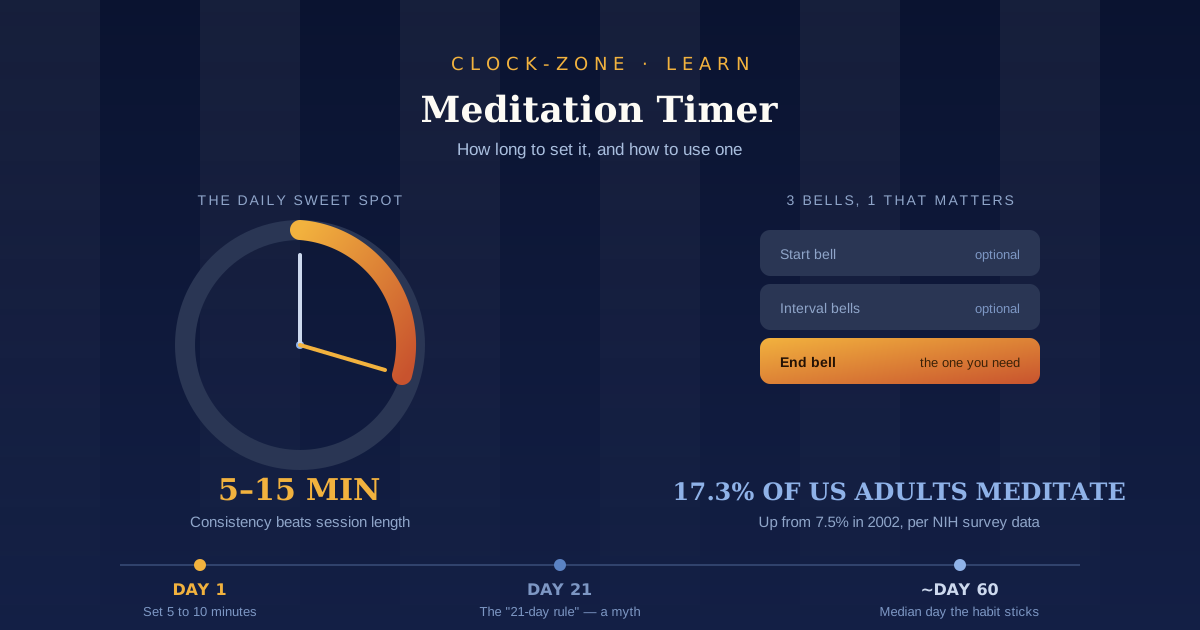
TL;DR: A meditation timer is a countdown that holds time for you so your mind doesn't have to. Set it, close your eyes, and a soft signal tells you when you're done. Most people do best at 5 to 15 minutes a day, because consistency matters more than session length. You don't need an app for this. A browser timer works on any device, with nothing to install.
You sit down. You settle. A few minutes pass, and then a small voice asks: how long has it been? You peek at the clock. And in that moment the practice is over, even if you had eight minutes left.
A meditation timer exists to break that loop. It is the least glamorous part of a practice and often the part that makes the practice possible. Set a duration, start it, and your attention is free to do the thing it actually came here to do.
More people are looking for that help than ever. Meditation use among US adults more than doubled between 2002 and 2022, from 7.5% to 17.3%, according to national survey data analysed by the NIH. Most of those people are not on retreat. They are sitting for ten minutes before work, and they need something to tell them when ten minutes is up.
This guide covers what a timer does, how long to set it, whether interval bells help, and how to start a session in under a minute.
What Is a Meditation Timer and How Does It Work?
A meditation timer is a countdown set to a fixed session length that ends with a soft bell, chime, or gong instead of a jarring alarm. You choose a duration, start it, and close your eyes. The timer tracks the time so you never have to check a clock mid-session.
That is the whole job. It sounds almost too small to matter, and it is the single most useful piece of equipment most meditators ever use.
The three signals a timer can give you
Most meditation timers offer up to three sounds, and you can use one, two, or all three:
- A start bell marks the beginning. Striking a note and listening to it fade is a small ritual that draws a line between the busy part of your day and the quiet part.
- Interval bells sound partway through. They tell you time is passing without you opening your eyes.
- An end bell closes the session. This is the one you actually need. The other two are optional.
As one guide to start, interval, and ending bells puts it, the value is in the slow fade. A resonant tone that decays gives the mind something gentle to land on instead of yanking it back.
Timer versus alarm clock: what is different
A standard phone alarm is engineered to override you. It is loud, it repeats, and it is designed for someone who is unconscious. Ending twenty minutes of stillness with that sound is like being shaken awake.
A meditation timer uses the opposite design. Same countdown, different exit. If you want a plain time display running nearby rather than a countdown, an online clock does that job without the alarm at all.
Why Use a Timer Instead of Just Watching the Clock?
Clock-watching is the most common distraction in beginner practice. Every glance restarts your attention from zero and tells your mind that tracking time is still its job. A timer takes that job away, which is the only way the mind fully lets go of it.
Think of it the way one meditation teacher does. Answering a student who wondered if a timer felt artificial, Ananda's teachers compared it to using a timer for the oven: it lets your mind do other things instead of worrying about burning the food.
There is a second reason, and it has nothing to do with meditation theory.
The phone problem
If your timer lives in your phone's clock app, you have to unlock your phone to start it. That means seeing your lock screen, your badges, and whatever arrived in the last hour.
Americans now check their phones 186 times a day, roughly 11.6 times per hour. And the cost of a single interruption is measurable: researchers found that one notification disrupts concentration for about seven seconds, with checking frequency predicting distraction better than total screen time does.
Seven seconds is not much. Seven seconds thirty seconds before you close your eyes is a different story. Opening a timer in a browser tab, or on a second device you keep face down, sidesteps the whole thing.
Fixed duration beats "as long as it feels good"
There is one more quiet benefit. When you decide the length in advance, you stop negotiating with yourself mid-session. Without a set duration, most people stop at the exact moment practice gets uncomfortable, which is usually the moment it starts working.
How Long Should You Set Your Meditation Timer For?
Set it to 5 to 10 minutes if you are new, 10 to 20 minutes once practice feels normal, and 30 to 45 minutes only if you have a specific reason. Frequency matters more than length. A daily seven-minute sit does more than a monthly hour.
Be a little sceptical of anyone who gives you a precise number. As one honest review of the literature points out, there is no clear scientific consensus on the optimal session length, and a lot of the advice online is tradition or marketing rather than evidence.
What the research does support is that short sessions are not a consolation prize.
What short sessions actually do
A 2019 study in Behavioural Brain Research had non-experienced adults meditate 13 minutes a day for eight weeks and found improvements in mood, attention, and memory compared with a control group. Cognitive scientist Amishi Jha's work with US Marines preparing for deployment found that sessions as brief as 12 minutes produced cognitive improvements.
At the other end, clinical Mindfulness-Based Stress Reduction programmes typically ask for 40 to 45 minutes of daily practice. That is a structured eight-week course with a teacher, not a starting point for someone squeezing practice in before the school run.
A duration guide by experience level
| Where you are | Timer setting | Notes |
|---|---|---|
| First month | 5 to 10 minutes | This is the correct dose, not a compromise |
| Regular practice | 10 to 20 minutes | Add an interval bell if you want one |
| Experienced | 20 to 30–45 minutes | Often split into two sits |
| Clinical programme | 40 to 45 minutes | Usually teacher-led, eight weeks |
The rule underneath the table: pick the length you will actually repeat tomorrow. Evidence consistently shows that regular daily practice outperforms sporadic long sessions across the outcomes researchers measure. A newer meditator sitting for thirty minutes usually spends most of it waiting for the bell.
Interval Bells: Helpful Anchor or Unnecessary Interruption?
Interval bells split a session into segments. Set one every ten minutes in a thirty-minute sit and you get a soft acknowledgment that time is moving, without opening your eyes to confirm it.
They are genuinely useful in three situations:
- Long sits. Past twenty minutes, the "how long has it been" thought gets louder. A bell answers it before you go looking for a clock.
- Breathwork. If your cycle has phases, a bell at each transition means you are not counting.
- Technique switching. Fifteen minutes of breath awareness, bell, ten minutes of loving-kindness.
They are a bad idea when you find yourself bracing for the next one. Some people spend the whole gap anticipating sound, which is worse than the clock-watching the bell was meant to prevent.
A useful way to choose comes from a guide comparing silent timers with bell timers for beginners: pick the style that reduces your most common distraction. If you peek at clocks, use bells. If sound makes you tense, go silent with an end signal only.
For most people starting out, one bell at the end is enough. Add intervals later, if and when a session gets long enough to need them.
How Do You Set Up a Meditation Timer Online?
Open a countdown timer in your browser, type the number of minutes, press start, and close your eyes. It takes about fifteen seconds, needs no account, and works the same on a phone, tablet, or laptop.
Here is the full setup, including the parts people skip:
- Open the timer. Use the free countdown timer on Clock Zone. It runs in the browser, so there is nothing to download.
- Set your duration. Enter minutes and seconds. Start lower than you think you should.
- Check your volume first. Play the end sound once before you begin. Discovering it is set to maximum after twenty minutes of stillness is not relaxing.
- Silence everything else. Do Not Disturb on your phone, notifications off on your laptop. The timer is the only thing allowed to make noise.
- Keep the tab open. Leave the timer tab in front. Some browsers throttle background tabs.
- Press start and settle. Take one slower breath before you close your eyes.
Anchoring the session to a fixed time
If your problem is remembering to sit rather than timing the sit, that is a different tool. Set an online alarm clock for the same time each day and let it be the cue that starts the routine. The countdown handles the session itself.
And if you prefer open-ended sitting where you record how long you lasted rather than deciding in advance, a stopwatch tool counts up instead of down.
We built Clock Zone this way on purpose. Every tool runs instantly in a browser with no download, no registration, and no subscription, because a tool you have to install first is a tool you skip on the mornings you least feel like practising. Removing that one step is often the difference between a habit and a good intention.
Common Mistakes That Break a Timed Practice
Most timer problems are small and fixable. These are the ones that come up again and again:
- Starting too long. Twenty minutes on day one usually produces nineteen minutes of frustration and no day two.
- Using a harsh alarm tone. If the sound makes you flinch, your nervous system learns to dread the end of practice.
- Restarting the timer when your mind wanders. Wandering is not a failed session. Noticing it and returning is the practice.
- Changing the duration daily. A stable length is easier to automate than a moving target.
- Meditating with the phone unlocked next to you. The device that ends your session should not also be the device delivering messages.
- Treating the bell as a hard stop. It marks the boundary, not an ejection. Sitting for another minute if you feel settled is fine.
How Long Until a Timed Meditation Habit Sticks?
Expect roughly two months, not three weeks. A 2024 systematic review found a median of 59 to 66 days for a new health habit to feel automatic, with individual times ranging from 4 to 335 days. If practice still takes effort at week three, nothing is wrong.
That review covered 20 studies and 2,601 participants, and the spread in its results is the important part. The mean times ran much higher than the medians, between 106 and 154 days, because some people take far longer than others.
The famous 21-day rule has no research behind it. It traces back to a plastic surgeon's observation about patients adjusting to their appearance, and it survives mostly because three weeks sounds like a reasonable amount of time.
What actually speeds it up
Context beats willpower. Researchers found that around 65% of everyday behaviours are triggered automatically rather than consciously decided, which means the goal is to attach your sit to a cue that already fires every day. After you brush your teeth. Before you open your laptop. Same place, same trigger.
Two practical notes. First, judge yourself on whether you started, not on how the session felt. Second, keep the duration boring and repeatable while the habit sets.
If you practise with a group across time zones, a time zone converter makes a shared sitting time easy to agree on, and a time duration calculator will add up your weekly minutes if tracking totals keeps you going.
Start With Ten Minutes
Three things worth keeping. The timer's only job is to hold time so your attention doesn't have to. The right length is the one you will repeat tomorrow, not the impressive one. And the habit takes about two months to settle, so early effort is normal rather than a sign you are doing it wrong.
You do not need a subscription or an app for any of this. Open the free countdown timer, set it to ten minutes, and sit. Bookmark it so tomorrow takes one tap instead of a decision, and send it to anyone who has been meaning to start.
The bell will let you know. That is the entire point.
Frequently Asked Questions
Is it better to meditate with or without a timer?
For most people, with. A timer removes clock-watching, which is the most common distraction in beginner practice, and it stops you ending a session at the first uncomfortable moment. Experienced meditators sometimes drop the timer for open-ended sitting, but that is a later choice, not a starting point.
What is the best meditation timer length for beginners?
Five to ten minutes. That is the appropriate dose for a new practice, not a scaled-down compromise. Research on brief sessions found meaningful benefits from 13 minutes a day over eight weeks, and 12-minute sessions produced cognitive gains in studies of US Marines. Build up only once the short version feels routine.
Should a meditation timer have interval bells?
Only if they solve a problem you actually have. Interval bells help in sessions longer than twenty minutes, in breathwork with distinct phases, and when switching techniques mid-session. If you find yourself anticipating the next chime, turn them off and use a single end bell instead.
Can I use a meditation timer without downloading an app?
Yes. A browser-based countdown timer works on any phone, tablet, or computer with no install and no account. This also keeps you out of your phone's clock app, which means you avoid seeing notifications right before you sit down.
What sound should a meditation timer make at the end?
A soft bell, chime, singing bowl, or gong. The useful quality is a tone that fades slowly rather than one that cuts off sharply, since a decaying sound draws attention back gently instead of startling you. Avoid your phone's default alarm, which is built to wake someone who is asleep.
Related Guides
- Study Timer: How to Use One and How Long — the same fixed-duration principle, applied to focused work.
- Best Free Online Timers in 2026 — honest picks compared, including which ones stay accurate in background tabs.
- How to Stop Hitting Snooze — the same quiet-rest and consistency research, applied to mornings.