How Flight Arrival Times Work
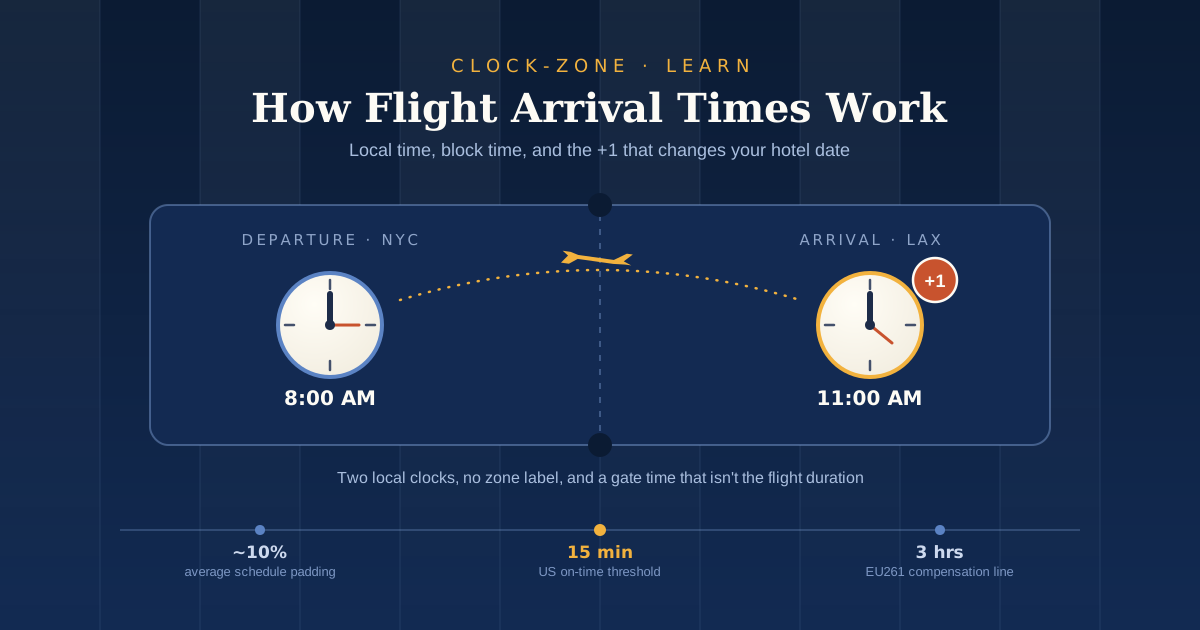
TL;DR: Every time printed on a boarding pass is local time at that airport, with no zone label attached. Arrival time means the moment the aircraft parks at the destination gate, not the moment the wheels touch the runway. Airlines pad these schedules by roughly 10 percent, which is why flights so often land "early". To find the true duration, convert both times into a single time zone first, then subtract.
Look at a New York to Los Angeles ticket. It departs at 8:00am and arrives at 11:00am, and yet nobody flies coast to coast in three hours. Look at a Tokyo to San Francisco ticket and it lands before it took off. Look at a Boston to Reykjavik ticket and there is a small "+1" sitting next to the arrival time that nobody ever explains.
Understanding how flight arrival times work clears up all three of these at once, and none of them are printing errors. They are the visible edge of a system that has to describe one continuous journey using two different clocks in two different places.
The rules are simple once someone spells them out. Every time on your ticket belongs to the airport it sits beside. Arrival means the gate, not the runway. And the number the airline published is not the number the pilots expect to fly.
This guide walks through what each part means, why the schedule has cushion built into it, and how to get a reliable answer when you are booking a hotel or picking someone up. It takes about ten minutes and you will never squint at an itinerary again.
What Does the Arrival Time on Your Ticket Actually Mean?
The arrival time on a ticket is the scheduled moment the aircraft is expected to park at the destination gate, expressed in the local time of the destination airport. It is not the touchdown time, and it is not the time in the city you left. Airlines schedule and measure arrival at the gate, not at the runway.
That single sentence resolves most itinerary confusion. The rest is detail.
Every time is local, and nothing says so
Boarding passes almost never label a time zone. The departure time belongs to the departure airport's zone. The arrival time belongs to the arrival airport's zone. The two numbers are printed side by side as though they are comparable, and they are not.
This is a deliberate convention, not laziness. Passengers care what the clock on the wall says when they walk off the plane, so airlines show the number that will be on that wall.
Scheduled, estimated, and actual are three different things
Airlines and airports track several arrival times, and they rarely match. In operational systems, the actual landing time and the actual time the aircraft reaches its stand are recorded as separate events, because taxiing and waiting for a gate can take a while.
For your purposes, three matter. The scheduled time is the one printed on your ticket, set months ahead. The estimated time is what the airline expects today, updated in flight. The actual time is what happened.
If you are collecting someone from the airport, watch the estimated time on a flight tracker, not the printed schedule. The printed one stopped being a prediction the moment the plane left the gate.
Why the Arrival Time Doesn't Match the Flight Duration
Here is the arithmetic that catches everyone. Take that New York departure at 8:00am arriving in Los Angeles at 11:00am. The clock difference on the page is three hours. The flight is closer to six.
The fix is to put both times into one zone before subtracting. Los Angeles runs three hours behind New York, so 8:00am in New York is 5:00am in Los Angeles. From 5:00am to 11:00am is six hours. That is your real flight duration.
The same method works in reverse, and it is the reason eastbound tickets look brutal. A five hour flight that starts at 9:00pm and crosses three zones eastward arrives at 5:00am, which reads like an overnight marathon on paper.
Two things trip people up here. The first is forgetting that some places use half-hour offsets, so an India or Nepal route will not resolve to a round number. The second is daylight saving, which can change the gap between two cities by an hour depending on the month. If either applies, it is faster to work out the true flight duration in a tool than to do it in your head.
If the offsets themselves are the confusing part, our guide to how UTC offsets work covers where those numbers come from and why some of them are not whole hours. For a one-off answer, a time zone converter does the subtraction in a second.
What Is Block Time and Why Do Airlines Pad It?
Block time is the scheduled duration from the moment the aircraft leaves the departure gate to the moment it parks at the arrival gate. It is always longer than flight time, because it includes taxiing at both ends and any holding in the air. Your ticket sells you block time, not air time.
The name comes from the wheel chocks. Airlines describe it as "chocks out to chocks in", with the clock starting when the blocks come away and stopping when new ones go down at the destination.
Block time versus flight time
Flight time is measured wheels-off to wheels-on. Block time wraps everything around it. Block time equals taxi out, plus airborne time, plus any airborne holding, plus taxi in, and at major hubs the taxi portion alone can add 20 to 30 minutes.
That gap explains a lot. A plane can land bang on time and still be recorded as late because it sat waiting for a gate.
Why your flight lands early
Airlines do not schedule the time a flight usually takes. They schedule that plus a cushion, so ordinary delays do not turn into official ones.
The cushion is substantial. An analysis of US government data on tens of millions of flights found that airlines pad scheduled flight times by just over 10 percent on average, adding roughly 11 minutes to a typical two hour flight, up from about 8 minutes in 2012. Padding varies by carrier, so the same route can be scheduled differently by two airlines flying identical aircraft.
The long-run trend is steeper. Research covering three decades of worldwide schedules found that scheduled block times rose by around 19 minutes per flight between the 1986 baseline and 2016, on routes where the aircraft got faster, not slower.
Some of that is genuine. Airports are busier and taxi queues are longer than they were. But there is also a competitive element, because when one carrier adds padding on a route, rivals tend to match it rather than look worse in punctuality rankings.
So when the captain announces you are arriving 15 minutes early, the flight usually took exactly as long as it always does. The schedule was generous.
What Does "+1" Mean on a Flight Itinerary?
A "+1" beside an arrival time means the flight lands on the next calendar day at the destination. It reflects the combination of flight duration and time zone shift, not a 24 hour journey. You will also see "+2" on very long routings and, more rarely, "-1" for flights that land the previous day.
The example most airlines use to explain it is a short overnight. A Boston departure at 6:20pm arriving in Reykjavik at 4:50am with a +1 is only a five and a half hour flight, because Iceland's clock is far enough ahead that the next day has already started when the wheels come down.
This matters more than it looks. The +1 is the date your hotel booking needs, the date your airport pickup needs, and the date your onward train ticket needs. Booking the room for your departure date is one of the most common travel mistakes there is, and it is entirely caused by a two character notation that most itineraries print in small grey type.
Check for it before you book anything on the ground. If your itinerary shows a 24 hour clock time with no am or pm, that is a good sign the airline is trying to remove ambiguity, but the date still needs checking separately.
How Can a Flight Land Before It Takes Off?
A flight can land at an earlier local time than it departed because crossing the International Date Line eastbound moves the calendar back a day. The plane still moves forward through time. Only the label on the clock and calendar changes, and it changes by more than the flight lasts.
Pacific routes produce the most dramatic versions. A five hour flight from Majuro in the Marshall Islands to Honolulu lands roughly 17 hours before it departed in local time, because the two airports sit on opposite sides of the line with a 22 hour offset between them.
Nothing is broken. You did not gain a day of life, you gained a day of calendar, and you will hand it back on the way home when a westbound crossing skips a date entirely.
If the mechanics of the line itself are what puzzle you, we cover the International Date Line and why it bends around island nations in more depth elsewhere. For booking purposes, all you need is the arrival date, and the itinerary is telling you the truth.
Why the Same Route Takes Longer One Way
Compare an outbound and a return on the same route and the block times will not match. This is not the airline hedging. It is wind.
Jet streams are fast bands of air in the upper atmosphere that flow broadly west to east, at the altitudes commercial aircraft cruise. Eastbound flights ride them as a tailwind. Westbound flights push into them as a headwind.
The effect is large enough to show up on your ticket. On transatlantic routes the directional gap is typically one to two hours, and it is strongest in winter when the temperature contrast that drives the jet stream is sharpest.
Occasionally it is spectacular. In February 2020 a storm supercharged the North Atlantic jet stream, and a British Airways 747 crossed from New York to London in under five hours, arriving 80 minutes ahead of its scheduled time.
Airlines build this into the schedule, which is why the westbound leg of your trip is published as the longer one before anybody checks a forecast. It also means the return leg of a round trip needs its own duration calculation. Do not assume it mirrors the outbound.
When "On Time" Has Legal Teeth
"On time" sounds like a description. It is actually a defined threshold, and two different definitions matter depending on where you are flying.
The 15 minute rule
In the United States, a flight counts as on time if it arrives at the gate less than 15 minutes after its scheduled arrival time. The same threshold is the industry norm worldwide, and it has been used to separate on time from late for decades, with exactly 15 minutes counting as late.
The measuring point is the part worth knowing. Although the 15 minute rule became standard through common usage rather than any formal ICAO or IATA adoption, measuring at the gate is the accepted practice, and using runway arrival instead tends to overstate performance. A flight that touches down on schedule and then waits 20 minutes for a stand is late.
For context on how often this bites, about 76 percent of US flights arrived on time through the first nine months of 2025.
The door-opening rule
In Europe the definition is stricter still, and money depends on it. Under EU261 and its UK equivalent, passengers can claim compensation when they reach their final destination three hours or more behind schedule.
The Court of Justice of the European Union had to decide exactly when a flight arrives. In a case where a delayed flight touched down 2 hours and 58 minutes late but reached its parking position 3 hours and 3 minutes late, the court ruled that actual arrival time is the moment at least one aircraft door is opened, because that is when passengers may leave. Five minutes of taxiing decided the claim.
The three hour threshold itself comes from earlier case law, and it applies to arrival at your final destination, including when a short delay on the first leg causes a missed connection. Departure delay is not the measure. Arrival is.
So there are three arrival times in play: the one on your ticket, the one the airline reports for statistics, and the one that decides whether you are owed anything. They can all be different numbers for the same flight.
How to Work Out Your Real Arrival Time
Convert the departure and arrival times into a single time zone, subtract to get the true duration, then add buffer for taxiing, immigration, and baggage before planning anything that happens after landing. Check the date notation separately from the time, because a +1 changes which day you actually need your hotel room.
A short checklist covers almost every case:
- Read the date first, then the time. A "+1" or "+2" is the detail that breaks hotel and pickup bookings.
- Convert before you subtract. Never compare the two printed times directly, since they belong to different clocks.
- Watch the estimated time, not the schedule. When collecting someone, use a live flight tracker. The printed number is months old.
- Add 30 to 60 minutes after gate arrival. Deplaning, passport control, and bags are not in the block time.
- Recheck around clock changes. Daylight saving dates differ by country, so the gap between two cities can shift by an hour.
- Give connections room. The scheduled arrival is padded, but the padding is there to absorb delay, not to give you extra transfer time.
For the conversion itself, a time zone converter handles daylight saving and half-hour offsets without you having to remember which apply. If you just want to know what time it is at the other end right now, the live world clock answers that in one glance.
Three Rules That Explain Every Itinerary
Everything above reduces to three things worth remembering. Every time on your ticket is local to the airport beside it, so never compare them directly. Arrival means the gate, which is why a plane can land on schedule and still be counted late. And the schedule carries a built-in cushion, which is why arriving early is normal rather than lucky.
We built Clock-Zone because this kind of check should take seconds. Fast, accurate time tools in the browser, with no download, no account, and no subscription, so converting two airport times is a ten second job rather than a mental puzzle at the departure gate.
Open the free online clock or the converter before your next booking, bookmark whichever you reach for, and send it to whoever is picking you up. Reading a boarding pass properly is a genuinely useful skill. Not having to do the maths under time pressure is better.
Frequently Asked Questions
Are flight arrival times in local time?
Yes. Every departure and arrival time on a ticket, boarding pass, or airport display board is the local time at that specific airport, usually with no time zone label shown. A flight leaving New York at 8:00am and arriving in Los Angeles at 11:00am departs at 8:00am Eastern and arrives at 11:00am Pacific. To find the actual duration you have to convert both times into one zone before subtracting.
What does +1 mean on a flight ticket?
A +1 beside the arrival time means the flight lands on the next calendar day at the destination. It reflects the flight duration combined with the time zone shift, not a journey lasting a full day. A five and a half hour overnight flight can easily carry a +1 if the destination clock is far enough ahead. Always use the +1 date when booking hotels, transfers, or onward travel.
Does flight arrival time mean landing or reaching the gate?
Reaching the gate. Airlines schedule and report arrival as the moment the aircraft parks at its destination stand, not the moment the wheels touch the runway. This is why a flight can land on schedule and still be recorded as delayed after a long taxi or a wait for a stand. Under EU261 and UK261, the standard is stricter again, since arrival is legally defined as the moment at least one aircraft door opens.
Why do flights often arrive early?
Because airlines build a cushion into the schedule. Analysis of US flight data found padding averaging just over 10 percent of scheduled flight time, which is around 11 minutes on a typical two hour flight. The buffer absorbs routine taxi queues and air traffic delays so ordinary variation does not create an official late arrival. When a flight lands 15 minutes early, it usually took the same time it always does.
How do I work out how long a flight actually takes?
Convert the departure time and the arrival time into the same time zone, then subtract. For example, an 8:00am departure from New York arriving 11:00am in Los Angeles becomes 5:00am to 11:00am once both are in Pacific time, so the flight is six hours. Remember that the result is block time, which includes taxiing at both ends, and that half-hour offsets and daylight saving can change the gap between two cities.
Related Guides
- World Time Zone Map Explained — how to read the offset bands and the date line your flight crosses.
- How to Convert Time Between Time Zones Without Mistakes — the 3-step method for subtracting two local times correctly.
- What Is UTC Time? Meaning, GMT vs UTC & Conversion — useful when a flight plan or timestamp is given in UTC instead of local time.