Egg Timer: Perfect Boiled Eggs Every Time
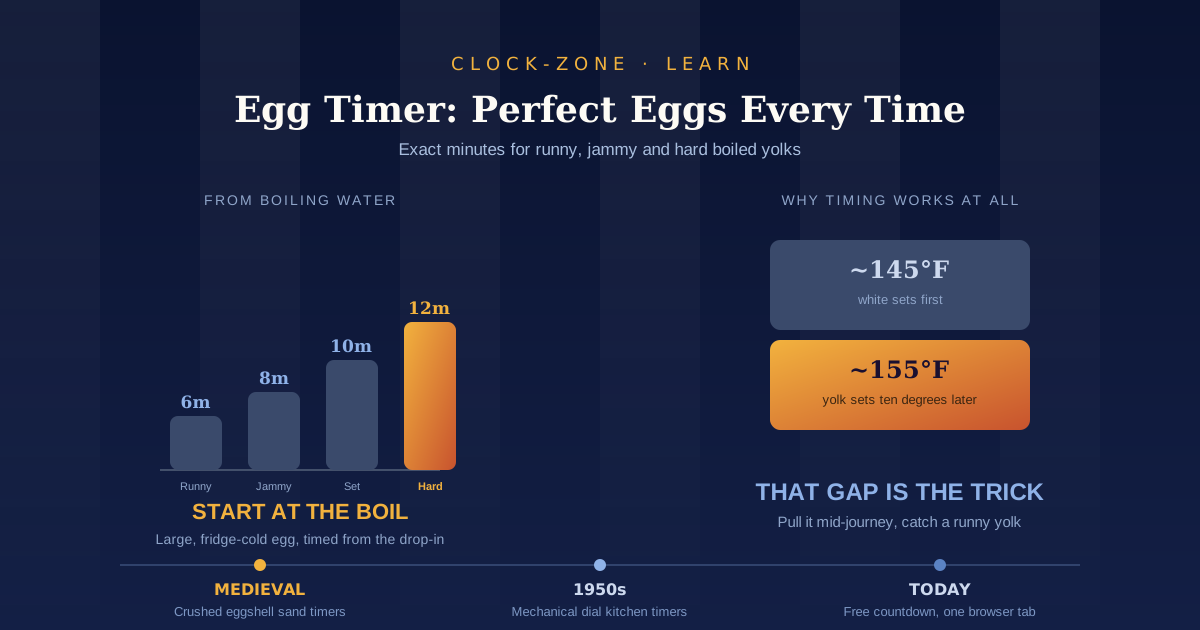
TL;DR: An egg timer counts down the exact minutes an egg needs. For a large egg going from the fridge into already boiling water, that's 6 minutes for a runny yolk, 8 for jammy, and 10 to 12 for hard boiled. Egg size, altitude and starting temperature all shift those numbers. Start your timer the moment the egg hits the water.
Almost nothing you cook is as unforgiving as an egg. Sixty seconds is the difference between a yolk that runs across your toast and one that crumbles like chalk. You can't see any of it happening, because the shell hides everything until you crack it open. That's the whole reason the egg timer exists as its own object, with its own name, in a kitchen full of tools that do broadly similar jobs.
The good news is that the numbers are simple once you know which assumptions they're built on. Most timing charts you'll find online quietly assume a large egg, straight from the fridge, lowered into water that's already boiling. Change any one of those and your result changes too.
This guide gives you the times, explains why they work, and covers the four variables that make a chart fail in your kitchen. If you just want the countdown running, open the free online countdown timer in a second tab and come back.
What Is an Egg Timer?
An egg timer is a countdown device built for one job: measuring the few minutes an egg spends in hot water. The name stuck even though modern versions time anything. Traditional models were small hourglasses, mechanical timers replaced them with adjustable dials, and today most people use a digital or browser-based timer instead.
The history is better than you'd expect. Sand timers were used for cooking as far back as the Middle Ages, and because clean sand wasn't available everywhere, people ground up eggshells and used those instead. The material behaved almost identically. So the earliest egg timers were, in a small way, made of eggs.
The classic sand version only measured one duration. Wikipedia notes the three minute model was made specifically for soft-boiled eggs, which tells you how narrow the original design brief was. Mechanical dial timers came later and could handle any cooking task, which is why "egg timer" and "kitchen timer" now mean the same thing to most people.
We built Clock Zone with that same one job idea in mind. You shouldn't need to install an app, make an account or pay a subscription to count down eleven minutes. You open a tab and it runs.
How Long Should You Boil an Egg?
For a large egg taken from the fridge and lowered into already boiling water: 6 minutes gives a runny yolk, 7 to 8 gives a jammy centre, 9 to 10 gives a set but moist yolk, and 11 to 12 gives fully hard boiled. Start timing the second the egg enters the water, and move it straight into ice water when the timer sounds.
That reference point matters more than the numbers. Every time below assumes a large egg, fridge-cold, going into water that's already at a boil. If a chart doesn't state its assumptions, it's probably hiding room-temperature eggs or a cold-water start, which is why its times never match yours.
6 minutes: runny yolk
The white is just set and the yolk still flows. This is the egg for dipping toast soldiers into, served upright in a cup. Go much under 6 minutes and the white near the yolk stays loose and slippery.
7 to 8 minutes: jammy yolk
The yolk turns thick and sticky rather than liquid, somewhere between a sauce and a solid. RecipeTin Eats treats 8 minutes as the everyday default, and it's the standard for ramen eggs, grain bowls and anything where you want the yolk to coat other food.
9 to 10 minutes: set but not dry
The yolk is firm around the outside with a slightly darker, moist centre. Fond describes 9 minutes as the useful compromise when you want an egg you can slice cleanly without the yolk turning powdery. It also travels better than a softer egg.
11 to 12 minutes: hard boiled
Fully set through, which is what you want for egg salad, deviled eggs and meal prep. Don't push past this. Natasha's Kitchen warns that cooking beyond 12 minutes raises the odds of a green ring around the yolk, and the whites start turning rubbery.
There's also a gentler route to the same place. Serious Eats uses a hybrid: 30 seconds at a hard boil, then 11 minutes at a bare simmer. It's more hands-on, but the eggs knock around less and crack less often.
The Science of a Set White and a Runny Yolk
Here's the thing that makes egg timing possible at all. Whites and yolks don't set at the same temperature.
Egg proteins go through a process called coagulation, where heat unfolds them and they lock together into a solid. The American Egg Board puts egg white coagulation between 144°F and 149°F, and yolk between 149°F and 158°F. The Institute of Food Science and Technology notes that full coagulation lands around 70°C, which is about 158°F.
That gap of roughly ten degrees is the entire trick. It's why a soft-boiled egg can exist. Heat travels inward from the shell, so the white reaches its setting temperature well before the yolk does. Pull the egg at the right moment and you catch it mid-journey, with a firm white wrapped around a liquid centre.
It also explains the failure mode at the other end. Once the yolk passes its setting point, more time doesn't improve anything. The proteins keep tightening and squeeze water out from between them, which is exactly what a rubbery white and a chalky yolk are. There is no upside to an extra two minutes.
Why Do Your Eggs Turn Out Different Every Time?
Four things move the number: egg size, starting temperature, altitude, and how many eggs are in the pot. Any single one of them can shift your result by a minute or more, which is enough to turn a jammy egg into a hard one. Charts assume large, fridge-cold eggs at sea level.
Egg size
Each size step is worth roughly 30 seconds. A medium egg needs about half a minute less than a large one, an extra large about half a minute more. If you're not sure what you have, assume large. It's the most common retail size, so guessing wrong costs you 30 seconds rather than a full minute.
Fridge-cold or room temperature
A room temperature egg is already partway warm, so it finishes around a minute sooner. This is the single most common reason a recipe's timing feels wrong. If you left your eggs on the counter and the chart assumed the fridge, you'll overshoot.
Altitude
This one surprises people. Water boils at a lower temperature as you go up, so your "boiling" water is genuinely cooler and cooks more slowly. The USDA notes that water boils at 208°F at just 2,000 feet, compared with 212°F at sea level, and treats 3,000 feet as the point where adjustments start to matter. NASA's figures put 5,000 feet at 203°F and 10,000 feet at 194°F.
In practice, a 3 minute egg in Denver behaves like a 4 to 5 minute egg. Add roughly 15 to 30 seconds per 1,000 feet above sea level and adjust from there.
How many eggs are in the pot
Six cold eggs pull far more heat out of the water than one. The water takes longer to climb back to a boil, and everything runs late. Use a bigger pot with more water, and keep the heat high enough that it recovers quickly.
How Do You Stop the Green Ring Around the Yolk?
The greenish-grey ring is ferrous sulfide, formed when sulfur in the white meets iron in the yolk. It's harmless and safe to eat. It shows up when eggs cook too long or cool too slowly, so the fix is to pull them on time and drop them straight into ice water.
Nebraska Extension confirms the ring comes from that sulfur and iron reaction and recommends cooling the eggs fast under cold running water or in an ice bath to prevent it. Slow cooling is the part people skip. The egg keeps cooking from its own retained heat after it leaves the pot, and that carryover is often what tips a good egg into a green one.
Egg age matters too, and this is less well known. America's Test Kitchen found that fresh eggs survived a full 15 minutes without greening, while month-old eggs turned green inside normal cooking times. Older whites are more alkaline, which speeds up the reaction. So if you're making deviled eggs for guests, reach for the newer carton.
Peeling is a separate battle, and the fix isn't what most people think. America's Test Kitchen compared five methods and found that both steaming and boiling scored top marks for clean peeling. What the winners had in common was a hot start. Eggs that begin in cold water and warm up gradually bond more tightly to the shell membrane.
Storing Boiled Eggs Safely
Once they're cooked, the clock starts on a different kind of timing. Boiling strips away the shell's natural protective coating, so cooked eggs actually spoil faster than raw ones.
The FDA advises using hard-cooked eggs within one week of cooking, whether they're peeled or still in the shell, and storing eggs at 40°F or below. The one week limit is the same either way, which contradicts the common belief that peeled eggs only last a day or two. That's a quality issue, not a safety one, because peeled eggs dry out in the open air. Keep them in a sealed container and they hold the full week.
Cooked eggs also shouldn't sit out for more than two hours. If you're doing Sunday meal prep, cool them, refrigerate them, and set a reminder for the following Sunday.
What Else a Kitchen Timer Is Good For
Once you have a countdown open, you'll find uses for it well beyond breakfast. The most famous one started in a kitchen anyway.
The Pomodoro Technique breaks work into 25 minute focused intervals with 5 minute breaks, and it's named after the tomato-shaped kitchen timer that Francesco Cirillo used as a student. A tool built for eggs turned into one of the best known productivity systems in the world. That's a good argument for keeping a timer within reach. Our full guide to the Pomodoro Technique covers the six official steps if you want to try it.
Other everyday uses:
- Tea. Green tea at 2 minutes, black at 4, and the difference between them is just as sharp as with eggs.
- Workout intervals. Our online stopwatch with lap times suits sprint splits better than a countdown does.
- Batch cooking. If you want a fixed wake-up rather than a countdown, the online alarm clock handles multiple alarms with labels.
- Kitchen second screen. A full-screen online clock on a tablet propped against the wall is easier to read across a room than a phone.
Conclusion
Three things to take away. First, every timing chart rests on hidden assumptions, so check that yours means a large, fridge-cold egg going into boiling water before you trust it. Second, the four variables that actually change your result are size, starting temperature, altitude and batch size, and each is worth roughly 30 seconds to a minute. Third, the ice bath isn't optional, because carryover heat keeps cooking your egg after you take it out.
Set the countdown timer before you put the eggs in, not after. It's free, it runs in your browser, and there's nothing to install or sign up for. Bookmark Clock Zone's free time tools and you'll have a timer one tab away next time you're standing over a pot.
Frequently Asked Questions
How many minutes is a perfect boiled egg?
It depends on the yolk you want. For a large egg from the fridge into boiling water, 6 minutes gives a runny yolk, 8 gives jammy, and 11 to 12 gives fully hard boiled. There's no single correct number, only the one matching how you plan to eat it.
Do you start the timer before or after the water boils?
After. Bring the water to a full boil first, lower the eggs in gently, and start the countdown at that moment. Cold-water starts also work, but they need their own timings, because you're measuring from when the heat goes on rather than from when the egg meets boiling water.
Why won't my boiled eggs peel cleanly?
Usually because they had a cold start. America's Test Kitchen found that eggs going into an already hot environment peel far better, since slowly warmed whites bond more tightly to the shell membrane. Both boiling and steaming work well. An ice bath afterwards helps too.
Can I use an online egg timer on my phone?
Yes. Clock Zone's countdown timer runs in any mobile browser with no app install and no account. Keep the tab open so the alarm can sound when time is up.
Is a green yolk safe to eat?
Yes. The greenish-grey ring is ferrous sulfide, formed when sulfur in the white reacts with iron in the yolk. It's a cosmetic sign of overcooking or slow cooling, not spoilage, though the egg may taste slightly more sulfurous.
Related Guides
- Study Timer: How to Use One and How Long — the same "protect the block" logic, applied to focused work.
- Best Free Online Timers in 2026 — how our timer and others compare on accuracy, ads and readability.