Daylight Saving Time Senate Debate: Where the Bill Stands Now
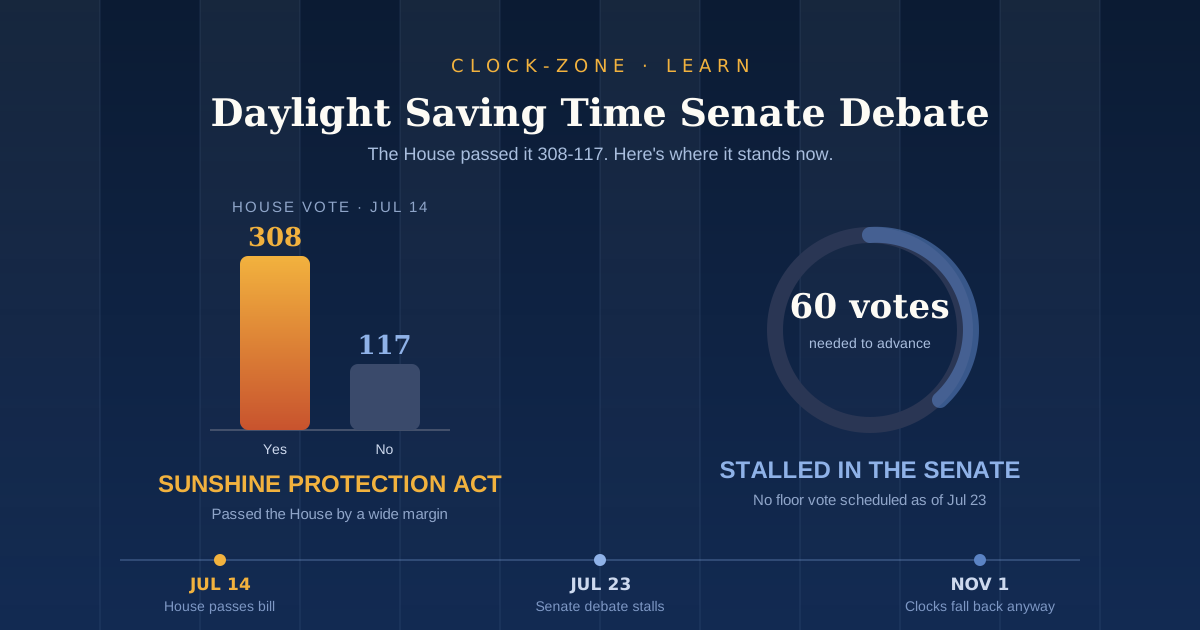
TL;DR: The House passed the Sunshine Protection Act on July 14, 2026, by a vote of 308 to 117, which would make daylight saving time permanent. The bill is now stalled in the Senate, where opposition splits by geography rather than by party. Northern and western senators warn about 9 a.m. winter sunrises. Nothing has changed yet, and clocks still fall back on November 1, 2026.
Status as of July 23, 2026. This story is moving quickly.
The daylight saving time Senate debate is the last hurdle standing between Americans and the end of twice-yearly clock changes. On July 14, the House passed the Sunshine Protection Act by a wide margin. The representative presiding over the vote played "Here Comes the Sun" on his phone as he read out the tally.
Nine days later, the mood in the Senate is very different.
Here's the part that surprises most people. This isn't a fight between Republicans and Democrats. Both parties have supporters and opponents, and the split follows a map instead of a party line. Senators from northern and western states are lining up against a bill that senators from southern states are happy to back.
This guide covers what the House actually passed, why the Senate is a tougher room, what the two competing proposals would mean in practice, and what happens to your clocks in the meantime. Every claim links to its source so you can check the reporting yourself.
What Is the Senate Debate Over Daylight Saving Time About?
The Senate is deciding whether to make daylight saving time permanent across the country. Most senators already agree the twice-yearly clock change should end. Where they disagree is which time the country should keep.
That distinction is the whole story, and it gets lost in most headlines.
Ending clock changes sounds like one decision. It's actually two. First, should we stop switching? On that, there's broad agreement. Second, should we lock in summer time or winter time? On that, there's no agreement at all.
Lock in daylight saving time and you get later sunsets year-round, plus much later sunrises in winter. Lock in standard time and you get earlier sunrises, plus darkness arriving early on winter evenings. You can't have both. The daylight doesn't change, only the labels we put on it.
What Did the House Actually Vote For?
On July 14, 2026, the House passed the Sunshine Protection Act by 308 to 117. The bill would put the country on the time currently observed from March to November, unless an individual state adopted permanent standard time before the law took effect.
The measure is sponsored by Rep. Vern Buchanan, a Florida Republican, and has President Trump's public backing. Trump wrote on Truth Social in May that he would work hard to see the bill signed into law.
The bill text is straightforward. It makes daylight saving time the new permanent standard time, and states with areas already exempt from daylight saving may choose the standard time for those areas.
That opt-out clause matters more than it sounds. In practice it works like a grandfather rule. A state has to already be on permanent standard time before the act takes effect. Right now, only Hawaii and most of Arizona qualify. No state currently observes permanent daylight saving time, because federal law doesn't allow it.
So for most of the country, the bill isn't optional. That's a point opponents keep returning to.
Why Is the Bill Stalling in the Senate?
Because the opposition is geographic rather than partisan, and the bill needs 60 votes to advance. Senators from northern and western states say their constituents would face winter sunrises as late as 9:30 a.m., and several have promised to block a fast-track vote.
Senate Majority Leader John Thune, a South Dakota Republican, told NOTUS the bill "has a lot of opposition" and added that he doesn't think senators want a federal mandate. He hasn't ruled out a floor vote, but he hasn't scheduled one either.
The math problem is straightforward. Sen. Tom Cotton of Arkansas blocked an attempt to fast-track the bill by unanimous consent in October, and he has vowed to object to any future attempt. That forces supporters onto the regular floor process, where they'd need 60 votes.
Sen. Steve Daines of Montana told CNN he doesn't think the bill "will see the light of day" on the Senate floor. He pointed out that sunrise in western Montana wouldn't arrive until 9:30 a.m. under permanent daylight saving time, which is a hard sell for parents putting children on school buses.
The committee record shows how cross-party this is. When the Senate Commerce Committee considered a version of the bill, Republicans including Ted Budd, Deb Fischer, Jerry Moran, Dan Sullivan and Todd Young voted against advancing it, alongside Democrats including Amy Klobuchar, Tammy Duckworth, Gary Peters and Jacky Rosen.
Look at the states those senators represent. Nebraska, Kansas, Alaska, Indiana, Minnesota, Illinois, Michigan. The pattern is latitude, not party.
There's one more group in the mix. Orthodox Jewish organizations have raised objections because morning prayer times are tied to sunrise, and permanent daylight saving time would push those prayers later into the working day.
And there's a practical obstacle that has nothing to do with the merits. Senate floor time is scarce, and leaders are reluctant to spend it on a bill that might fail.
Permanent DST vs Permanent Standard Time
Three options are actually on the table, not two. Here's how they compare.
| Option | Winter sunrise | Winter sunset | Status |
|---|---|---|---|
| Keep switching (current system) | Early | Early | In effect now |
| Permanent daylight saving time | About one hour later | About one hour later | Passed the House |
| Permanent standard time | Early | Early | Competing bill |
The competing measure is the Sunshine for Our Kids Act of 2026, a bipartisan bill that would make standard time permanent instead. Americans would keep the winter clock setting all year, which means earlier sunrises and earlier sunsets.
The case for permanent daylight saving time. Supporters argue later sunsets give people more usable daylight after work, which encourages outdoor activity, helps retail and hospitality businesses, and may reduce some categories of crime. Evening rush hour is busier than the morning one, so more evening light could reduce crashes.
The case for permanent standard time. Supporters argue it matches the body's natural rhythms, avoids dangerously dark winter mornings for schoolchildren and early-shift workers, and doesn't require anyone to start their day in darkness for months at a time.
The case for keeping the current system. Almost nobody makes it. Support for the status quo is the weakest position in the whole debate, which is exactly why the issue keeps coming back.
What the Evidence and the Polling Actually Show
On the medical side, the science leans one way. The American Academy of Sleep Medicine states that permanent standard time aligns best with human circadian biology, and that seasonal clock changes carry risks to physical health, mental health and public safety.
That position isn't a lone voice. The AASM statement was endorsed by 20 medical, scientific and civic organizations, and the American Medical Association has called for permanent standard time as well.
On the economic side, the picture is messier. Supporters of permanent daylight saving time point to real findings. One study in the Review of Economics and Statistics found roughly a 7% decrease in robberies following the shift to daylight saving time. Stanford researchers note that golf courses and open-air malls are among the strongest backers, since evening light is good for their business.
Other economic claims are genuinely contested. Energy savings, crash rates and stock market effects have all produced conflicting studies. Anyone telling you the data is settled in either direction is overstating it.
Public opinion is clearer on one point only. An AP-NORC poll found that just 12% of American adults support the current system of switching clocks, with nearly half opposed. But polls consistently show far less agreement on which permanent option people prefer.
One expert point is worth flagging because it rarely comes up. The same Fortune reporting notes that a permanent switch might require redrawing time zones, since each of the four zones covers so much longitude that sunrise already varies widely between their eastern and western edges.
Has the US Tried Permanent Daylight Saving Time Before?
Yes, and it didn't last. Congress made daylight saving time permanent in January 1974 during the oil crisis. Public support fell from 79% to 42% within two months, and the law was repealed that October.
The sequence is worth knowing, because it shapes how senators are thinking today.
President Nixon signed the Emergency Daylight Saving Time Energy Conservation Act in December 1973, and the change took effect on January 6, 1974, as a trial meant to run about 16 months. Then winter mornings arrived. In cities including Detroit, Indianapolis, Minneapolis and Seattle, the sun didn't rise until around 9 a.m., and support collapsed. President Ford signed the repeal on October 5, 1974.
The historian David Prerau, who wrote a book on the subject, says the policy became very unpopular very quickly.
One honest caveat belongs here. Much of the 1974 backlash centered on child pedestrian deaths in dark mornings, and the government later found the evidence for an actual increase was weaker than the public reaction suggested. The lesson historians draw isn't that permanent daylight saving time is provably dangerous. It's that people tend to like the idea in December and dislike it in February.
What Happens Next, and What It Means for Your Clocks
Nothing changes right now. The bill has passed one chamber of Congress. For it to become law, the Senate must pass the same text and the President must sign it.
Three paths are realistic from here. The Senate could schedule a floor vote and test whether supporters can find 60 votes. Leadership could let the bill sit and quietly expire at the end of the session, which is what happened to the 2022 version after it cleared the Senate and died in the House. Or negotiators could try to merge the competing proposals, though the two bills point in opposite directions.
For now, the practical answer is simple. Daylight saving time still ends on Sunday, November 1, 2026, when clocks fall back one hour. Daylight saving time in 2026 began on March 8. Those dates hold unless a new law changes them.
If you coordinate with people in other states or countries, the transition weekend is the moment things get confusing. The US, Europe and the southern hemisphere all shift on different dates, so time gaps that felt stable for months suddenly move. A time zone converter sorts that out faster than doing the arithmetic in your head, and a world clock shows you what several cities are doing at once.
We built Clock-Zone to take that guesswork out. The tools read your device's system time, so daylight saving transitions are handled automatically. There's nothing to adjust and nothing to install, whichever way this debate finally lands.
The Bottom Line
Three things are worth remembering. The House passed the Sunshine Protection Act by a wide bipartisan margin. The Senate is where it stalls, and it needs 60 votes it may not have. And the dividing line runs across the map rather than between the parties, which is why this is harder to predict than a normal party-line bill.
Watch for two signals. If Senate leadership schedules floor time, supporters think they have the votes. If the competing permanent standard time bill starts gathering cosponsors, the debate is shifting rather than ending.
Until then, the clocks change on November 1. Set a reminder now with a browser alarm clock, or bookmark the online clock and let your device sort it out for you.
Frequently Asked Questions
Has the Senate passed the daylight saving time bill?
No. As of July 23, 2026, the Sunshine Protection Act has passed only the House, by a vote of 308 to 117 on July 14. Senate leaders have not scheduled a floor vote, and Majority Leader John Thune has said the bill faces significant opposition among senators from both parties.
What is the Sunshine Protection Act?
It's a bill that would make daylight saving time permanent nationwide, ending the twice-yearly clock change. The country would stay on the time currently observed from March to November. States already on permanent standard time, meaning Hawaii and most of Arizona, could keep it if they adopted it before the law took effect.
Would permanent daylight saving time mean darker mornings?
Yes, in winter. Sunrise would come about an hour later than it does now under standard time. Senators from northern and western states have warned that some areas would not see sunrise until 9 a.m. or later, with one citing a 9:30 a.m. sunrise in western Montana.
What is the difference between permanent daylight saving time and permanent standard time?
Permanent daylight saving time keeps the summer setting all year, giving later sunsets and later sunrises. Permanent standard time keeps the winter setting, giving earlier sunrises and earlier sunsets. Sleep medicine organizations, including the American Academy of Sleep Medicine and the American Medical Association, support permanent standard time.
Do the clocks still change in November 2026?
Yes. Daylight saving time ends on Sunday, November 1, 2026, when clocks fall back one hour. Nothing in the current legislation has taken effect, so the existing schedule applies unless a new law passes and is signed first.
Related Guides
- Daylight Saving Time Explained — why clocks change at all, and what the research says about energy and health.
- World Clock: How to Check the Current Time in Any City — confirm the current offset instead of guessing whether a change has landed.
- How to Convert Time Between Time Zones Without Mistakes — for the international calls this bill would eventually simplify.